
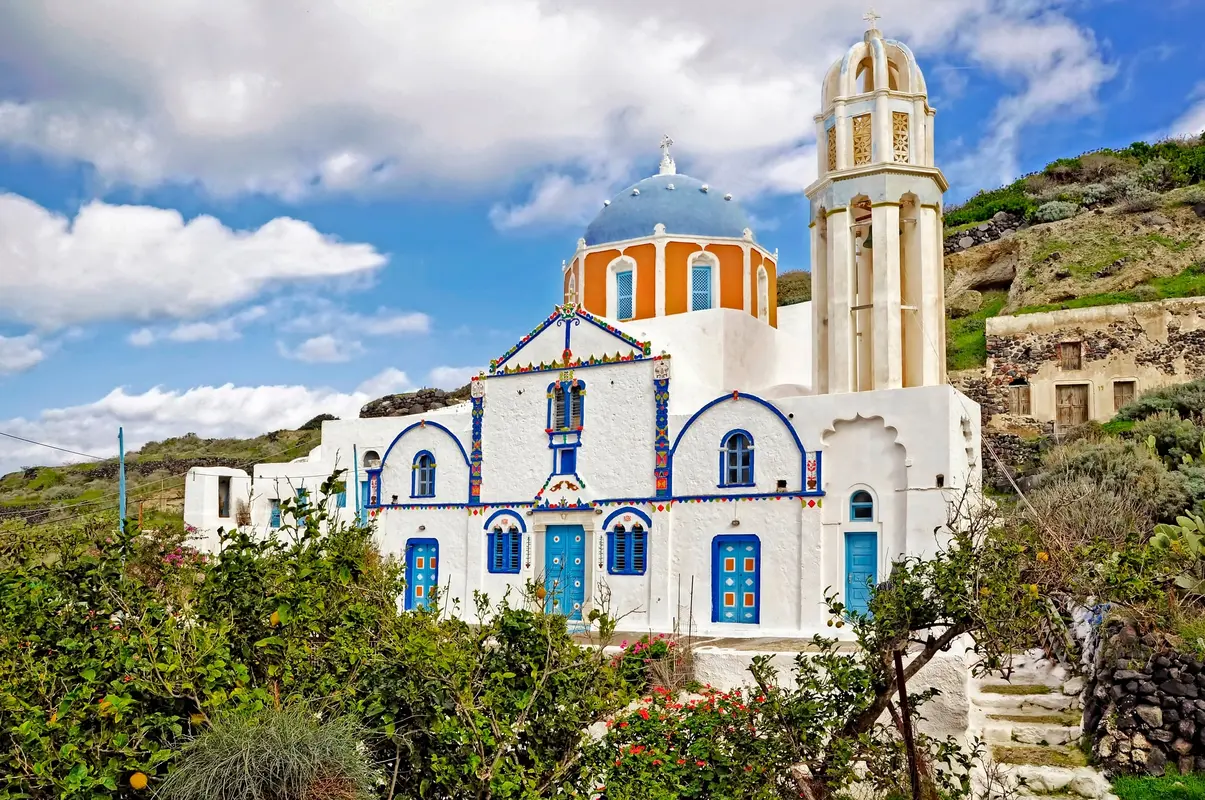
Quick answer:On 24 September a boat leaves Ammoudi Bay at 12:15 for a Thirassia day trip, and comes back around 17:30, and in between you walk the piece of the caldera that broke away in the Minoan eruption, and was never rebuilt for tourism in the modern times, making it the perfect time machine to glimpse a different Santorini. About 140 people live in its main village, Manolas. The walk also takes in Agrilia, a deserted cliff settlement of cave dwellings with no electricity and no running water, standing since the people left.
€50 for the guided walk, lunch by the sea at extra cost, organized by Santorini Experts.
Those departure and return times are the point: you’re away for exactly the hours Oia can be at its busiest and hottest, and back before it gets dark.
Thirassia day trip: the timing is the whole point
The boat goes out of Ammoudi at 12:15 and comes back around half past five, which means it takes the middle of the day off your hands.
Late September isn’t August, and the 24th isn’t a heavy cruise ship day, so Oia’s main lane may be slightly less shoulder-to-shoulder. But it’s still the high season, and the village fills up fast; the hours between noon and five are the ones you’d look back on and wonder where they went. Those are the very hours you’d spend across the caldera, where only a couple of hundred people live, and you’d be back with the whole evening still in front of you, just in time for a Greek music night at Besalou restaurant in Oia.
I’ve spent most of this summer telling people to go inland when the sun is at its worst. This is the same thought, carried over to our “little sister” island.
Why go on a Thirassia day trip, from my point of view
I saw it through photographs before I ever went there.
The photographer Vangelis Paravas documented the deserted settlements of Thirassia—Agrilia first, then Kera—and his pictures are why the island got into my imagination to begin with. What they show isn’t ruins in the picturesque sense, but a whole new way of building. It still has students of architecture mesmerized into trying to retrace its deceptively simple shapes.
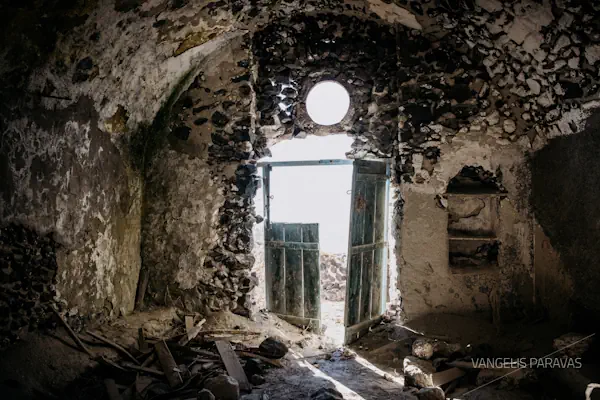
Kerà: Caves and Canaves
He describes Kerà as standing on the verge of the caldera with no electricity and no running water, the houses cut into the top layer of volcanic tephra that people here call àspa. Each household the same shape: the living part facing the caldera, and beside it the canava.
A canava space isn’t just a wine cellar. It’s the powerhouse of a Santorinian household, its whole family identity. Santorini’s volcanic soil yields distinctive grape varieties (such as Assyrtiko, Athiri, and Aidani), so owning a canava meant a grape grower possessed the complete knowledge and tools to craft, ferment, and age their own wines.
Thirassia Day Trip: the Details
24 September. Ammoudi Bay at 12:15. Back around 17:30. €50 per person for the guided walk. Lunch by the sea is separate—you pay for your own.
It’s organized by Santorini Experts, and they’re the ones to book it with.
I’m not running this one and I don’t get anything from it. I’m telling you about it because it goes somewhere I think is worth going.
The thing about the name
Santorini is named after a church of Saint Irene, but which church?
One candidate is the basilica at Perissa, on Santorini itself. The other is Santa Irini on Thirassia, whitewashed, built in 1867, standing at the neck of the caldera where returning sailors would sight it and call out the name—National Geographic ran that story last month.
I’d rather give you the argument than pick a side, as I find the argument more interesting than a definitive answer. An island named for a saint, and two churches on two islands both insisting it had to be theirs.
Agrilia, and why it emptied out
Agrilia is a cave-house settlement set into a gorge. A few decades ago, up to seven hundred people lived there. It was an agricultural community, and what it grew went to the tomato paste factories on Santorini. When those closed after the Second World War the reason for the village went with them, and the earthquake of 1956 finished what was left.
I wrote recently about the exhibition at the tomato museum in Vlychada, which is about exactly that industry: the factories, the work, the people who did it. Agrilia is the other end of the same story. The museum has the machines. The gorge has the houses of the people who supplied them.
Manolas, where people still go about their daily lives
About 140 people, at the top of the cliff, facing us across the water.
It sits up there for a reason. The village was built at the island’s highest point to keep watch for pirates: Barbarossa’s ships were coursing these waters in the 1500s, and a village you can see from is a village you can run from. Now the same height is what gives you the view.
You reach it by road from Riva, or by two hundred and eighty stone steps up from Korfos. From up there, you see the whole rim at once.
Thirassia day trip: lunch time
The €50 covers the guided walk. Food and drink are not included—you pay for your own lunch on the day, so bring cash or a card and budget for a taverna meal on top. Saying that plainly because the listing mentions a seaside lunch and it’s easy to read that as part of the price.
Most day visitors to Thirassia eat at Korfos, where the boats come in, and go no further. The tavernas there sit right on the water and there’s nothing wrong with them.
Up in Manolas, though, there are two places worth the climb. Fyrgano is the village favorite, with a kitchen downstairs and a terrace above it, and salads made from the owner’s own garden. Panorama does something more ambitious—dishes like baby calamari moussaka, or sea bass with beetroot hummus and sea fennel from Tinos.
Thirassia day trip and Mikra Thira Winery
And if you want to drink something grown there, there’s Mikra Thira, near the hamlet of Potamos. It’s the first winery ever built on Thirassia, which tells you something on its own—three of Greece’s best-known winemakers, Vangelis Gerovassiliou, Vassilis Tsaktsarlis and Ioanna Vamvakouri, had the idea in 2007 and didn’t manage to build it until fifteen years later.
Ioanna Vamvakouri
Vamvakouri is the one making the wine. The vines here are ungrafted and most are over eighty years old, trained in koulouri, the ground-level baskets that curl the plant around its own fruit to keep the meltemi off it. Among the Assyrtiko there are old Athiri and Aidani vines mixed in, and she says they work the way roses do in a vineyard—they catch disease before the rest of the planting does, so the vineyard tells you something is wrong while there’s still time.
I like that as a way of thinking about the place: an island where the old things left standing turn out to be the useful ones.
Two other things worth knowing about Thirassia
The pumice quarried on Thirassia went into the Suez Canal; the mines are disused now and you walk past them along the hiking route.
And then there’s the church the islanders call the Mexican Church, for its peach and yellow paint. Where can you find it?
Come along to find out!
It’s just been in National Geographic
National Geographic Traveler ran a piece on Thirassia on 8 August this year, calling it Greece’s best-kept secret. It’s worth reading—it covers Santa Irini, the wineries, and the hiking—though it’s worth knowing it was produced with support from a hotel on the island, Marketing Greece, and a ferry company, which is disclosed at the foot of the article.
What a feature like that means, of course, is that the quiet has a clock on it. Not this year and probably not next. But the phrase “best-kept secret” in a magazine with that reach is the beginning of the end of the thing it’s describing, and everyone on the island knows it.
Go now, is what I’d say.
Thirassia Day Trip: Frequently Asked Questions
What is the Thirassia day trip from Oia?
A boat crossing from Ammoudi below Oia to Thirassia, the island across the caldera, with a guided walk through the main village of Manolas and the deserted settlement of Agrilia, and a stop for lunch by the sea. The September 2026 walk departs Ammoudi at 12:15 and returns around 17:30, priced at €50 per person for the walk, and is organized by Santorini Experts. Food and drink are not included in that price—you pay for your own lunch on the day.
Why go to Thirassia instead of staying in Oia?
Timing and quiet. The crossing covers the middle of the day, when Oia is at its hottest and busiest, and returns before the evening light. Thirassia has about 140 residents in Manolas, no cruise berth, no coach parking, and no sunset crowd.
What is Agrilia on Thirassia?
A deserted settlement of cave dwellings on Thirassia’s cliffs, cut into the volcanic tephra that islanders call àspa. It has no electricity or running water and stands roughly as its inhabitants left it. Along with nearby Kerà, it’s among the clearest surviving examples of Cycladic cave-dwelling architecture.
What is a canava in Santorini and Thirassia?
A canava is a household winery cut into the rock, not simply a cellar. Grapes were crushed there at harvest, the must fermented in excavated tanks called linoi, the wine aged in wooden barrels, and raki was distilled from the pressed skins. On Santorini most canavas are now tasting rooms or hotel spaces; on Thirassia many remain as they were.
How many people live on Thirassia?
About 168 people live on Thirassia, roughly 140 of them in Manolas, the main village. Manolas sits at the island’s highest point—built there to watch for pirates in the 1500s—and is reached by road from Riva or by 280 stone steps up from Korfos.
How do you get to Thirassia from Oia?
By boat from Ammoudi, the small port below Oia. A ferry also runs from Athinios, Santorini’s main port. Crossings are seasonal and the meltemi wind can affect sailings, so confirm times for the day you plan to travel.
Is Thirassia less crowded than Santorini?
Substantially. Thirassia has no cruise berth, no airport, and no coach traffic, so visitor numbers depend entirely on small boats. It stays quiet even in peak season, which makes it the most reliable day away from the caldera villages.
How long do you need on Thirassia?
Half a day covers Manolas, a walk, and lunch. A full day suits anyone wanting to walk between settlements or spend time at Korfos or Riva. Plan around the boat times rather than the other way round.
Is Santorini named after a church on Thirassia?
Possibly, but it’s disputed. The name derives from Saint Irene, and two churches claim it: the basilica at Perissa on Santorini, and Santa Irini on Thirassia, built in 1867 at the neck of the caldera, which returning sailors would sight and call out by name. Some sources state the Thirassia version as settled fact; historians have not agreed on it. Thirassia has 24 churches in total, on an island roughly 5.5 miles long and 1.5 miles wide.
Why was Agrilia on Thirassia abandoned?
Its economy disappeared. Up to 700 people lived in the cave-house settlement, farming produce for the tomato paste factories on Santorini. Those factories closed after the Second World War, and the 1956 earthquake accounted for what remained. The houses are still standing in the gorge.
How do you get from Ammoudi to Thirassia and how much does it cost?
A sea bus crosses from Ammoudi Bay below Oia to Riva Port on Thirassia in about ten minutes, running several times a day for roughly a euro. A longer ferry runs from Athinios, Santorini’s main port. Schedules are published online and change seasonally, so check before traveling.
Where do you eat on Thirassia?
Most day visitors eat at Korfos, where the boats arrive, at tavernas set right on the water. In Manolas, the village at the top, Fyrgano is the local favorite with produce from the owner’s garden, and Panorama Resto serves more ambitious cooking. Mikra Thira winery near Potamos pours assyrtiko from vines grown in the traditional koulouri baskets and runs a 90-minute tour.
Is lunch included in the Thirassia guided walk?
No. The €50 covers the guided walk only. There’s a stop for lunch by the sea, but you pay for your own food and drink on the day, so budget for a taverna meal on top of the ticket price.
Thirassia Day Trip: the Details
24 September. Ammoudi Bay at 12:15. Back around 17:30. €50 per person for the guided walk. Lunch by the sea is separate—you pay for your own.
It’s organized by Santorini Experts, and they’re the ones to book it with.
I’m not running this one and I don’t get anything from it. I’m telling you about it because it goes somewhere I think is worth going.