What’s September in Santorini really like?
September in Santorini isn’t the shoulder season anymore, whatever the old blog posts keep telling you. Greece’s own cruise levy classifies 1 June to 30 September as peak season and charges accordingly, dropping the fee only on 1 October.
The first half of the month runs busy, expensive and reservation-heavy. The weather is excellent: highs around 25°C (77°F), the sea at its warmest of the year at about 25°C (77°F), rain on roughly one day or never, and a weakening meltemi wind.
Two things worth knowing before you book: the island empties noticeably in the second half of the month, and the sun sets 45 minutes earlier on 30 September than on 1 September.
Santorini in September: What the numbers say
Average high around 25–26°C (77–79°F). Average low around 19–20°C (66–68°F). Sea temperature about 24–25°C (75–77°F), as warm as it gets all year, because the water has spent the whole summer heating up and it’s slower to let go.
Rain falls on about one day in the month, if ever. Ten to eleven hours of sunshine. The UV index drops to about 7, down from 9 in August, which is the first month since spring you can be outside at midday without the sun working against you.
Sunset is around 19:45 at the start of the month and just after 19:00 by the end. That’s the fact worth writing down.
September is still peak season, so don’t expect the quiet.
For years the standard advice was: avoid August, come in September, same weather and half the people.
Enough people took that to heart, so the travel blogs describing September as the shoulder season are now… talking about something that doesn’t exist anymore. Read them closely and they contradict themselves inside a paragraph: quieter month, peak prices, book your restaurants weeks ahead.
You don’t have to take my word for it: Greece’s cruise levy charges €20 a head at Santorini during peak season, and it defines peak season as 1 June to 30 September. On 1 October it drops to €12.
There’s a second thing worth knowing, because it explains why the crowding in Oia doesn’t shift yet all that much. The island’s 8,000-a-day cruise cap applies only to cruise passengers, while flights and SEAJET daytrips aren’t capped, so the number of people standing in the lanes at six in the evening isn’t the number the cap controls.
Somethng worth coming for: Ifestia 2026
Ifestia, the volcano festival, used to be held in August. The municipality moved it to September—to the third Saturday, where it’s been ever since—specifically to pull visitors into a month that needed them.
But this September is genuinely quieter than 2024’s, for a reason nobody planned: there are fewer ships. Scheduled cruise calls for 2026 are down about 18% on last year — 595 against 728 — and air traffic fell sharply after the 2025 earthquake swarm. The island is less pressed than it was at its worst, yet the gap between the crowded lanes and the hidden lanes continues growing.
None of this is a reason not to come. It’s a reason to be precise about which version of September you’re booking.
The month splits in half
The first two weeks are still August: cruise arrivals calendar full. Oia’s sunset lanes overflowing, restaurants needing booking. If you arrive on 3 September expecting a quiet island you’ll be disappointed, and it won’t be the island’s fault.
Then it turns. European school holidays end, the last big wave leaves, and somewhere around the middle of the month the island slows down. Same weather, same warm sea, noticeably fewer people. Tables free up. The caldera path is walkable at hours that were impossible in August.
If you have any flexibility at all, take the second half. That’s where the September people were promised actually lives now — and if your dates are fixed in the first half, the answer is the same one that works in August: go inland in the middle of the day, and meet the famous places early or late.
What Santorini in September is like, from over here
There are two Septembers on this island and they barely touch.
The island’s own calendar restarts in September too, and the sign of it is arrivals rather than departures. The teachers come. New ones, posted here for the year, stepping off the ferry into a place they’ve only seen in photographs and looking for somewhere to live in a month when nothing is cheap. Then the children go back to school. That’s the week the island stops being a resort and starts being a village again — and it happens while your holiday is still going on around it.
The season doesn’t end in September. Nobody’s leaving yet. What happens is that the island’s own year starts up again underneath the visiting one, and for a few weeks both are running at once.
The grape harvest
The harvest is finished by now, or nearly. The grapes came in during August and the work has moved indoors, into the cellars, where it’s cool and dark and nothing about it is photogenic. This is the part of wine-making nobody sells tickets to, and it’s the part that decides what the wine will be.
And on 8 September there’s another feast for the Virgin — her birth, this time. It’s kept quietly. After the scale of August, that quiet is the point: the island has just spent a fortnight fasting and then feasting, and this one is small on purpose. It’s the second Marian feast in under a month, and the difference between them tells you more about how the year works here than either would alone.
White walls go warmer, the rock across the caldera goes redder in the evening, and the hour before sunset stretches. Photographers know this. Most people just feel it and don’t know why the pictures look better.
Ifestia: 19 September 2026
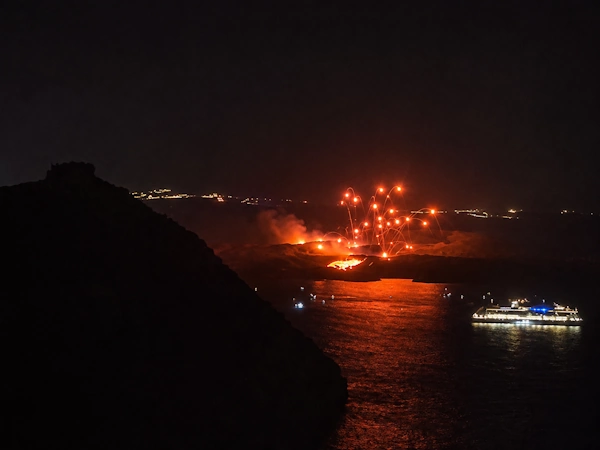
The volcano festival. After dark on the third Saturday of September, fireworks go up from Nea and Palea Kameni in the middle of the caldera, staged as a re-enactment of the eruption that made this island what it is. It’s free, and it’s visible from the caldera-facing villages — Fira, Imerovigli, Oia — and from boats, which fill the water below.
It started by accident. In 1991 someone put a fireworks display at the end of a concert, the response was big enough that they did it again the following year, and it’s run every year since.
A note on the date, because the internet is confused about it: it’s Saturday 19 September in 2026. You’ll find pages saying 21 September, and older ones still saying late August. The rule is the third Saturday of September.
Where to watch it, and where not to
The fireworks launch from the islets in the middle of the caldera, so how good your view is comes down to how directly you’re facing them and how far away you are.
Fira is the place to be. It sits closest to the volcano and looks straight at it. The caldera-edge stretch through Fira — PK Cocktail Bar, the Character restaurant zone, the hotels along that rim — has the best views on the island. These places know it, so book ahead. Not on the day.
Firostefani works too, a little further along the same rim.
Imerovigli sees it, and this is where people get caught out. The fireworks are visible from up there, so every guide says Imerovigli is a viewing spot, and technically it is. But you’re watching it from a distance. It’s a different evening from being in Fira.
My personal mistake last year
I learned this the hard way — I wasn’t in Fira last year, and I should have been.
Boats in the caldera get closest of all, and they sell out.
Oia is the furthest from the volcano of any of the caldera villages. If Ifestia is the reason you’re out that night, don’t spend it in Oia.
Whatever you choose, be in place well before dark, because the roads and the caldera path fill up.
Ifestia is Saturday 19 September. The good spots go early.
I live here, and I know which side of the caldera to be on. Tell me your dates and I’ll build the day around them.
The sunset trap
In early September the sun goes down around 19:45. By the end of the month, just after 19:00.
That’s a 45-minute shift inside four weeks, and it catches people out constantly — dinner booked for 20:30 “after sunset” that turns out to be an hour after dark, or a drive to Oia timed from a blog post written in July. Check the actual sunset time for your actual date. It’s the cheapest planning win of the month.
The compensation is that the light gets better. Lower sun, softer, longer golden hour before it goes.
The nights are the part people miss
Here’s what doesn’t make it into the guides: the thing that makes summer days here hard is exactly what makes the evenings good.
By nine o’clock the stone has let go of its heat, the wind has softened, and you can sit outside for hours without thinking about the temperature once. That’s every night from June through September, and it’s the most reliably pleasant weather this island produces.
And the island does things at night that it doesn’t do by day. Village feasts run late — the panigiria, with the food and the live music and the dancing that goes as long as people want it to. Concerts happen in courtyards and churchyards. Squares that were empty at two in the afternoon fill up at ten. None of it is scheduled for visitors, which is why none of it is on the day-tour circuit.
Day-trippers and cruise passengers on Santorini in September see none of this.
They’re gone by late afternoon, which means they see the island at its hottest, its most crowded, and its least like itself. Then they write that Santorini is overrated.
This is the real argument for staying the night rather than passing through. Not the sunset — the two hours after it, when the island stops performing and starts living. If you’re here on a ship for a day, that’s a different plan, and worth building carefully. But if you can stay, stay.
What’s still open, and what starts closing
Early September, everything runs. Late September, some family-run places begin cutting back hours or closing for the season, and a few boat operators wind down.
This is less of a problem than it sounds — it’s mostly the seasonal businesses that exist for peak volume. The places that are open year-round because people live here stay open.
Santorini in September: the wind, and what it means for boats
The meltemi weakens through September but it doesn’t stop on a schedule. Windy days still happen, and they still make the sea rough, which matters if a catamaran day or a ferry is part of your plan.
Build a spare day around anything on water. Not because it’ll definitely be canceled — because the alternative is a ruined plan with no slack in it.
What September is genuinely best for
Swimming, first. The sea is warmer than in July, which surprises people every year.
Walking, second. The villages in September are what they can’t be in August: warm enough to be outside all day, cool enough to actually want to. My village walks are at their best in this month, and I say that as someone who runs them in every month.
And the light. Photographers know this already.
Santorini in September: Frequently Asked Questions
What is the weather like in Santorini in September?
Warm and dry. Average highs around 25–26°C (77–79°F) and lows around 19–20°C (66–68°F), with roughly one rainy day in the month and ten to eleven hours of sunshine a day. The UV index drops to about 7 from August’s 9.
Is the sea warm enough to swim in Santorini in September?
Yes—it’s at its warmest of the year, around 24–25°C (75–77°F). The water holds the summer’s heat longer than the air does, so September swimming is more comfortable than July. The east-coast beaches at Kamari and Perissa run slightly warmer than the caldera side.
Is Santorini crowded in September?
The first two weeks are still peak season, with cruise ships in port and Oia’s sunset lanes full. From roughly the middle of the month the crowds thin noticeably as European school holidays end, while the weather stays much the same.
Is September a good time to visit Santorini?
It’s one of the two best months, alongside June. Warm days, the warmest sea of the year, very little rain, and a lighter meltemi. If you can choose, take the second half of the month over the first.
What time is sunset in Santorini in September?
Around 19:45 at the start of the month and just after 19:00 by the end—a shift of about 45 minutes across four weeks. Check the date-specific time before booking dinner or planning an evening in Oia.
Can you see the grape harvest in Santorini in September?
Usually not. Santorini’s harvest runs early, with much of the picking done in August, and by September the work has generally moved into the cellars. Wineries are open and pouring throughout the month.
Does anything close in Santorini in September?
Early September everything is open. Toward the end of the month some seasonal businesses reduce hours or close, particularly beach operations and some boat tours. Year-round village businesses stay open.
What is there to do in Santorini at night in summer?
Evenings are the most comfortable hours of the summer—the stone has cooled, the wind drops, and it’s warm enough to sit outside for hours. Village panigiria run late with food, live music, and dancing; courtyard and churchyard concerts happen through the season; and village squares fill up long after the day-trippers have left. Most of it isn’t scheduled for visitors, so it doesn’t appear on tour listings.
Is September still the quiet month in Santorini?
Not in the first half, and officially not at all: Greece’s cruise passenger levy defines peak season as 1 June to 30 September, charging €20 per passenger at Santorini and dropping to €12 only on 1 October. Early September runs busy and expensive, with full sunset lanes in Oia and restaurants requiring reservations. The island quietens noticeably in the second half of the month.
Has the cruise ship cap made Santorini less crowded?
Partly. The 8,000-passenger daily cap applies to cruise arrivals only—flights and ferries are not capped—so congestion in Oia and Fira continues at peak times. Scheduled cruise calls for 2026 are down about 18% on 2025, at 595 ships against 728, which does make this season lighter than 2023 and 2024 at their peak.
What is September like for people who live in Santorini?
It’s the month the island’s own year restarts underneath the visiting one. Teachers arrive for the new school year and children go back to school, which turns the place back into a village while the season is still running. Most people working in tourism have gone since April without a break, and the end is finally in sight. The grape harvest is finished and the work has moved into the cellars.
Are there festivals in Santorini in September?
Yes, though quieter than August. 8 September is the Nativity of the Virgin, kept modestly across the island—the second Marian feast within a month, and a deliberate contrast to the scale of 15 August. Music and film events run through the month, mostly in Fira and at the open-air cinema in Kamari.
When is the Ifestia volcano festival in Santorini in 2026?
Saturday 19 September 2026. Ifestia is held on the third Saturday of September each year, with a fireworks re-enactment of the volcanic eruption launched from Nea and Palea Kameni in the caldera after dark. It’s free to watch from the caldera-facing villages. Some listings incorrectly give 21 September or late August—the festival was moved from August to September by the municipality to extend the season.
Where is the best place to watch the Ifestia fireworks in Santorini?
Fira. The fireworks launch from the islets in the middle of the caldera, and Fira sits closest and faces them most directly—the caldera-edge bars, restaurants and hotels along that stretch have the best views, and they book up well in advance. Firostefani is a good second. Imerovigli sees the display but from noticeably further away, and Oia is the furthest of the caldera villages from the volcano.
Santorini in September: Here for Ifestia weekend?
Fireworks on the Saturday, and a whole island either side of it. I’ll shape the days around what you actually want to see.