
What is August 15 in Santorini known for?
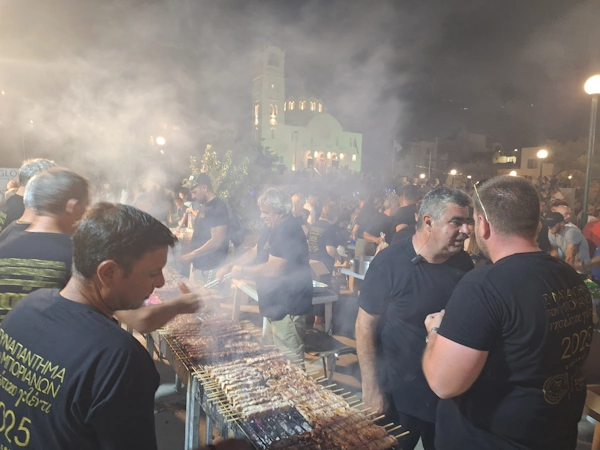
August 15 is the Dormition of the Virgin—Panagia—and it’s the biggest day of the Greek summer, bigger than Easter in some villages. For Santorini, specifically, it isn’t a single event: rather, every village with a church named after the Virgin holds its own, and they’re wildly different in scale. Panagia Episkopi is the oldest one, while Akrotiri’s is tiny, spontaneous and belonging entirely to the village. Emporio throws a big barbecue bash with live music that runs late into the night. There’s a gathering near Oia too, the most discrete of all. The celebrations themselves are free and none need booking, though Emporio’s evening concert charges €10. Turn up as a guest, not an audience.
August 15 in Santorini: What the day actually means to the locals
The Dormition of the Virgin Mary, or Koimisis, refers to her literally falling asleep. The Orthodox Church doesn’t call it death, and that word choice carries the whole theology of the day: she sleeps, she’s taken up, and it was all as it was meant to be. It’s the last feast of the church year, and it’s often called the ‘Easter in summer.’
In lots of villages, it outdoes the actual one.
To fully understand it, you have to understand that four things come together on the date.
It’s the end of a fasting period
In the first fourteen days of August, fasting excludes meat, dairy, and for many, oil on some days. Then on the 15th it ends, at a table, in public. That’s why the food is the center of the day rather than a minor detail, and why the grandparents get the cauldrons going at Episkopi the night before.
You’d be watching two weeks of restraint end all at once.
It’s a national holiday
As a result, the country shuts down. Ferries fill in both directions, because everyone is going somewhere that means something to them, an Odyssey on speedrun.
It’s a name day for a huge share of the country
Maria, Marios, Panagiotis, Panagiota, Despina, Panos—anyone carrying a version of the Virgin’s name celebrates on the day. In Greece a name day counts for more than a birthday. So half the people at any panigiri are also being congratulated personally, which is why chronia polla flies around all evening in every direction.
And it’s the one day the village feels complete
Greeks who moved to Athens, to Germany, to Australia come home for it. Emporio’s event is called the Gathering of the Emporians, and that’s the literal purpose, the single night of the year a village contains all of its own people again.
Throw those four together, and you’re walking into a family occasion that happens outdoors, on a village-wide scale. They’ll welcome you anyway—which, on a day dedicated to a mother, is exactly the point.
Most panigiria start the evening before. Liturgy, then food, then music, then dancing that goes as long as people want it to go. Nobody sells you a ticket; the village cooks and the village eats, knowing every beat instinctively.
The main celebrations to know about
Panagia Episkopi (Episkopi Gonia Village), the oldest one
This is the most talked-about one, and it’s old in a way that’s hard to overstate. The church is 11th-century, built under the emperor Alexios I Komnenos, and it was the seat of the Orthodox bishopric here and later the Latin one. So, its panigiri is among the oldest in the Aegean.
The cooking starts on the 14th. Beans and fava go into enormous cauldrons in the churchyard, and the hosts hand out the bean stew (fasolada) with Santorini wine to everyone standing there on the day. Hundreds of people come, on the eve and on the day.
Inside is the icon of the Panagia Glykofilousa—the Sweetly-Kissing Virgin—which came to the church as a gift from the same emperor who built it. People queue to venerate it, as per the Greek custom, and that queue is the whole point of the day for many, especially among the older generations.
This year there’s a second reason to go
The old evening panigiri at Episkopi is back after many years—the one that used to happen after the liturgy, when people stayed on, ate together and drank a glass of wine.
The Pagkratios Cultural and Environmental Association of Kamari has brought it back, with the Episkopi Gonia community, the Municipality of Thira and the Metropolis.
20:30, in the car park outside the church. Free entry, free food and wine.
Argyris Arvanitis plays, with Vangelis Schoinas on laouto and Michalis Valvis on bass and bouzouki, joined by Antonio Arvanitis, Gianna Mavrommati and young Giorgos Valvis. The association’s dance groups will be performing traditional dances.
If you only go to one thing on the 15th and you want to see what a village panigiri used to be, this is the night — and it’s the first time in years anyone has been able to say that.
Akrotiri: Panagia tis Koimisis, out toward the lighthouse
Run by the village itself — the cultural and athletic association, the association of Akrotirians, and the local community council.
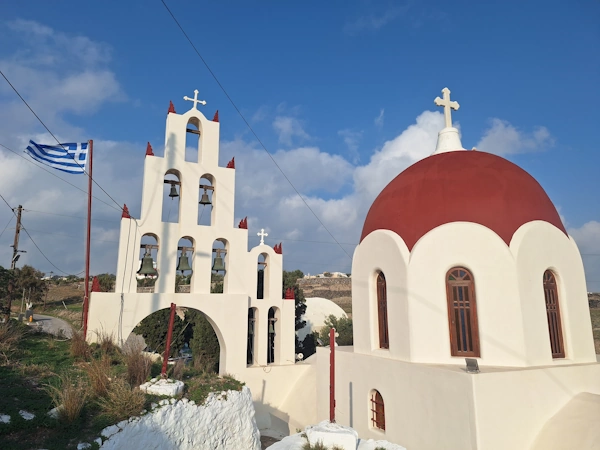
This is the one I’d send you to if you want to understand what these days are for. It isn’t built for visitors, which is exactly why it’s worth being there quietly.
It runs across two days, and the big night is the 14th
Thursday 14 August, 19:00: Great Vespers, and the panigiri follows straight after. This is the night. Music from Τα Αηδονάκια, the brothers Averkios and Nikos Vassalos on violin and laouto, and the association’s dance groups.
Friday 15 August, 07:00: the Divine Liturgy, early. A glenti follows through the morning with the same traditional panigiri.
When to come
If you can only do one, come on the evening of the 14th. If you want the liturgy, be there at seven on the 15th and go inside with your shoulders covered — the celebration carries on outside afterwards and runs well into the morning.
Why isn’t there a Google Maps pin?
Give yourself more driving time than the map says. The church sits by the lighthouse at the far southwestern tip; it’s a proper drive from Fira or Oia, on a morning when the whole island is moving. Park where you can and walk the last stretch rather than trying to get close.
And take a hat and water. There’s no shade out there, the sun is already hard by half past ten in August, and the celebration is outdoors. If you’re only doing one panigiri and you want the small, real version, this is it—and being finished by early afternoon means the rest of your day stays cool.
It’s soulful in a quieter, more understated way.
Emporio, the big barbecue bash
The Συναπάντημα των Μποριανών, the gathering of Emporio’s people, starts at 21:00 in the municipal car park, run by the village’s cultural association and its counterparts in others. The concert is ticketed at €10—the celebration around it isn’t, but they do expect you to pay for the food in the main square, unlike at the other feasts.
The name tells you what it is: the night the village’s own people come back, from Athens and further, and eat together. Live music, food, and it goes late. Emporio is one of the island’s most striking villages anyway, with its kastelli and its unknown lanes.
Panagia Kalou, near Oia, and many more
A gathering outside Oia, away from the sunset traffic entirely, out on the new road towards Pori.
Megalochori and Karterados both hold their own; Karterados at Panagia tis Kokkinis, Santorini’s red-domed church (as the story goes, originally painted with red wine when the sailors run out of water, but that’s a post for another day). If you’re staying somewhere with a church named for the Virgin, ask locally: there’s probably something happening two steps away.
August 15 in Santorini: How to be there properly
This is the part most articles skip.
You’re welcome. Nobody will ask what you’re doing there. But these are religious feasts and village occasions before they’re anything else, so a few things matter.
Cover your shoulders if you go into the church. Don’t photograph the liturgy, and don’t photograph people’s faces without asking—a phone at eye level during the service is the one thing that will make you conspicuous.
Eat if you’re offered food. Refusing is stranger than accepting.
Learn chronia polla. It’s what everyone says to everyone on a feast day, and it costs you nothing.
And if there’s dancing, watch the first few rounds before you join. Somebody will pull you in eventually. Let them.
Getting around on the day
Roads are busy and parking near the bigger panigiria fills early. If you’re going to Episkopi, go early or expect a walk.
Taxis on this island are limited on a normal night, and August 15 is not a normal night. Book anything you need well ahead, or plan to stay put once you’re somewhere.
The week around it
August 15 sits in the fullest week of the Greek summer. Ferries book out, roads are busy, and the island holds more people than any other week of the year. I wrote about how to plan a day around that heat and those crowds in Santorini in August.
If you’re here that week and want the middle of the day to be cool and quiet rather than a queue, the art and music side of the island is where I’d send you.
Small things you’ll only notice if you know
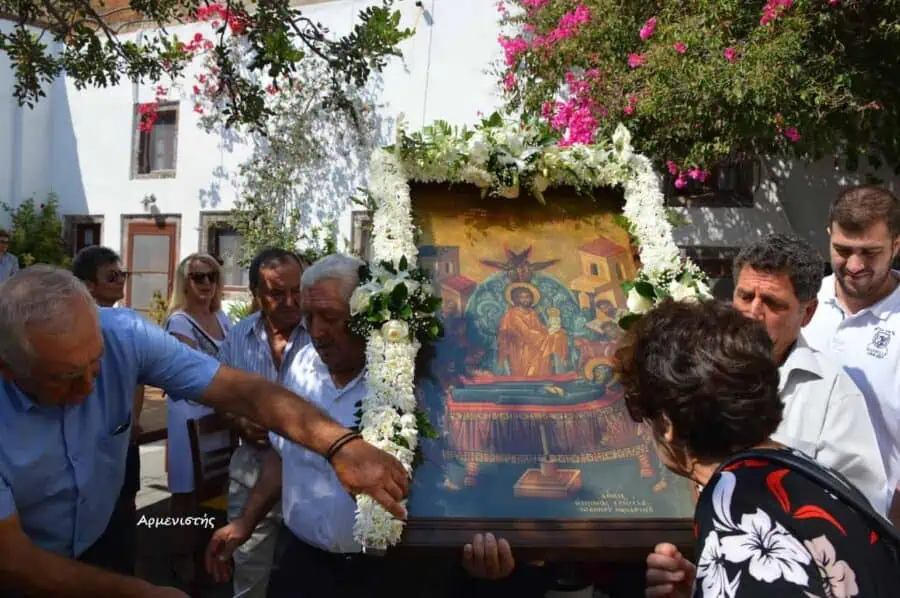
The Virgin has an Epitaphios. Most visitors know the flower-covered bier from Good Friday. On this feast the island does it again for her — a bier for her body, carried in procession. In Megalochori it goes through the whole village, and the egkomia, the praises, are sung in front of it at Vespers.
If you’ve seen a Greek Easter, you’ll recognize exactly what you’re looking at and understand why it’s the summer Easter.
Panagia tou Kalou was built because of something bad. The Virgin of the Good takes her name from the Kolumbo eruption of 1650 — the great Evil, as the island called it. A church named for the good that came after. The sea lilies grow around it, which brings me to the next thing.
The white flower on the beaches in August is not decorative. The krinaki, the sea lily, comes up out of the black sand in exactly these weeks. It’s the flower of this feast, and it appears without anyone planting it, in the hardest, driest month, on ground that looks like it holds nothing.
Rosemary and bay at the door. Look at what’s laid outside the churches. Not florist flowers — rosemary and laurel, cut from somewhere nearby.
Panagia i Kokkini at Karterados is red for a reason. When they were building it there wasn’t enough water on this island to make the mortar. So they mixed it with red wine.
And the island has around thirty names for her. Not thirty churches — thirty epithets. Mesa and Exo, Kokkini, tou Kalou, Marmarini, Episkopi, Foinikiotissa. Each one is a village’s own way of saying which Panagia they mean.
August 15 in Santorini: Frequently Asked Questions
What is Dekapentavgoustos?
Dekapentavgoustos means “the fifteenth of August” in Greek. It’s the feast of the Dormition of the Virgin Mary—Koimisis, her falling asleep—and it’s the last great feast of the Orthodox church year. It’s often called the summer Easter, and in many villages it draws bigger crowds than Easter itself.
Why is August 15 so important in Greece?
Four things fall on the same date. It’s a major religious feast, it ends the two-week August fast, it’s a national holiday when families return to their home villages, and it’s the name day for anyone called Maria, Panagiotis, Panagiota, or Despina—so a large share of the country is celebrating personally as well.
What happens in Santorini on August 15?
Villages across the island hold panigiria—a liturgy, then food, wine, live music, and dancing, usually starting the evening before. Panagia Episkopi at Mesa Gonia holds the largest. Akrotiri, Emporio, Megalochori, and Karterados all hold their own, and smaller churches do too.
Where is the biggest August 15 festival in Santorini?
Panagia Episkopi at Mesa Gonia. The church is 11th-century, built under the emperor Alexios I Komnenos, and its panigiri is among the oldest in the Aegean. Beans and fava are cooked in large cauldrons from the eve of the 14th and shared with Santorini wine in the churchyard on the day.
Can tourists attend Greek village festivals on August 15?
Yes. Panigiria are open to everyone and need no booking. They’re religious and community occasions before they’re anything else, so dress modestly if you go into the church, don’t photograph the liturgy, and accept food if it’s offered—refusing is stranger than accepting.
Are Santorini’s August 15 festivals free?
Yes. The church celebrations, the food shared in the churchyards, and the village feasts cost nothing. Ticketed concerts are separate—Emporio’s evening concert on the 15th is €10—but the celebration around it is free.
Is August 15 a good time to visit Santorini?
It’s the busiest week of the year. Ferries, roads, and villages are all at capacity, and the heat is at its peak. If you’re already here, the panigiria are the most alive the island gets all year. If you’re still choosing dates, know what you’re arriving into.
Are shops and restaurants open on August 15 in Santorini?
Most tourist businesses stay open, though some family-run places close for the feast or serve limited hours. Banks, public offices, and many local shops close for the national holiday.
What do you say to people on August 15 in Greece?
Chronia polla—literally “many years.” It works as both a feast-day greeting and a name-day one, which is why you’ll hear it constantly on the 15th. Anyone named Maria or Panagiotis is celebrating their name day, so it’s their day twice over.
What is happening at Panagia Episkopi on August 15, 2026?
Two things. The liturgy and the traditional sharing of fasolada and Santorini wine in the churchyard during the day, and—for the first time in many years—the old evening panigiri, revived by the Pagkratios Cultural and Environmental Association of Kamari with the Episkopi Gonia community, the Municipality of Thira and the Metropolis. It starts at 20:30 in the car park outside the church, with live traditional music, dancing, and free food and wine.
What time is the August 15 celebration at Akrotiri, Santorini?
It runs across two days at the church of the Dormition, on the road toward the Akrotiri lighthouse. Great Vespers is at 19:00 on 14 August, with the panigiri following straight after—that’s the main night, with live traditional music and the local dance groups. The Divine Liturgy is at 07:00 on 15 August, and a celebration follows through the morning. Entry is free.
Does Santorini have an Epitaphios for the Virgin, like at Easter?
Yes. On the Dormition the island carries a flower-covered bier for the Virgin and sings the praises before it, in the same form as the Good Friday Epitaphios. In Megalochori it is carried in procession through the village. It’s a large part of why the feast is called the summer Easter.
What is the white flower that blooms in Santorini in August?
The krinaki, or sea lily (Pancratium maritimum). It comes up out of the black volcanic sand in mid-August, in the driest weeks of the year, without being planted. It grows around Panagia tou Kalou and is associated with this feast.
August 15 in Santorini: Celebrate with the Locals
Curious about Santorini’s more soulful, sincere side? Tell me your dates, and I’ll take it from there.