
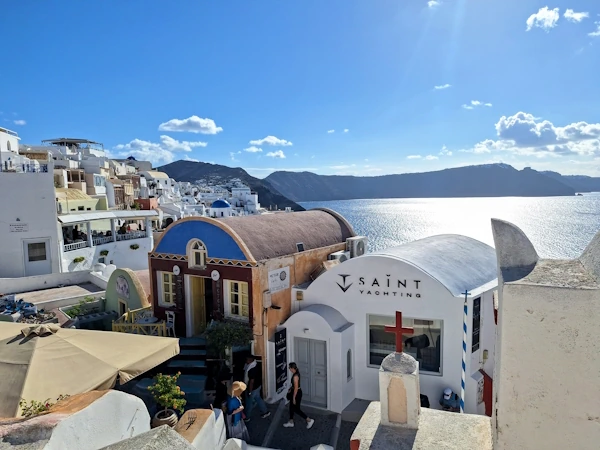
Quick Answer: Why does Santorini feel more tiring than people expect?
Santorini can feel more tiring than expected during the main season, even with a light itinerary.
This isn’t about distance. It’s about energy demand.
- Movement is physically demanding (stairs, heat, wind, crowds)
- The environment is visually and socially intense
- Small decisions accumulate throughout the day
- Plans often need constant adjustment
Most people don’t do too much.
They spend more energy than they expect.
Quick Answer: Can Santorini still feel quiet and relaxing?
Yes, if you plan around your own energy levels as well as views. Santorini doesn’t need to feel exhausting; it starts to feel good when youbalance intensity with recovery.
- Pair a high-energy moment (a walk, a viewpoint, a village)
with a pause that lets it settle - Choose fewer transitions, but make them meaningful
- Let part of the day be held, not optimized
A simple structure works:
- One rich, sensory experience
- One grounded, quieter moment
That’s where Santorini shifts from tiring to memorable, and that’s exactly the structure I use when I design your days on the island.
Santorini doesn’t need more planning.
It needs better pacing.
You’ve researched. You’ve saved posts and planned carefully. And still, may leave feeling more tired than expected, without quite knowing why.
You start wondering if you planned it wrong.
Or if Santorini just isn’t for you.
That disconnect rarely comes from disappointment. It comes from underestimation.
Not of the beauty, but of how the island actually works.
This piece isn’t a warning. It’s an orientation, about the parts of Santorini that don’t show up clearly before you arrive.
Nothing is wrong.
You’re just experiencing the island as it actually is.
Why Santorini feels tiring: Energy matters more than distance
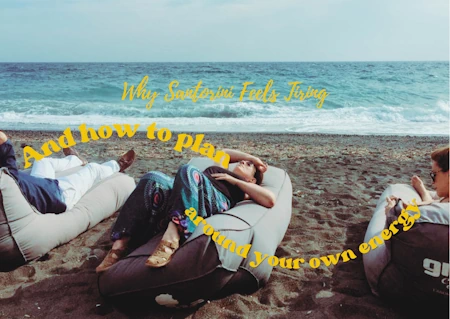
Santorini is small, so on a map, everything looks close.
And that’s exactly where expectations break.
In reality, short distances can feel long, as anyone who’s ever gone grocery shopping on foot here can tell you.
Movement takes effort: steep paths, midday heat, wind that pushes back, crowds that slow you down—none of it shows up on Google Maps.
A day with only a few stops can still feel exhausting.
What’s often underestimated isn’t how far you go, but how much energy each transition asks for.
This isn’t a flaw. It’s how the island works.
Once you see it this way, something shifts.
You stop trying to keep up.
You start choosing differently.
Why Santorini feels tiring: Visibility goes both ways
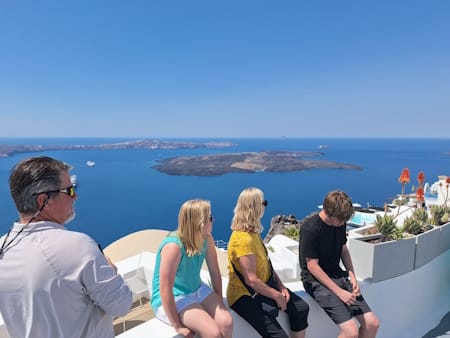
Santorini is visually open.
You’re often seen. There’s little anonymity. Beauty is everywhere, and contrast is constant. That can feel exhilarating. It can also feel unexpectedly draining.
Some people are energized by this. Others realize they need more privacy than they expected.
What’s underestimated isn’t the crowds. It’s how constant visibility affects how you feel and move.
Why Santorini feels tiring: Decision load accumulates quickly
Even simple days require many small choices.
When to move. Where to pause. How long to stay. Whether to adjust or hold the plan.
Those decisions stack.
And by the end of the day, it’s not the walking that exhausts you.
It’s the constant deciding
People often assume that fewer activities automatically mean less effort. But without structure, decision-making quietly fills the space instead.
Planning fatigue in Santorini doesn’t always show up as doing too much. It can also be just too many micro-decisions at once.
Why Santorini feels tiring: Rhythm is set by conditions, not intention
Santorini runs on rhythms that don’t announce themselves.
Wind shifts plans. Heat slows movement. Cruise schedules alter flow. Light changes timing.
The island shifts constantly, and it doesn’t warn you first.
What’s underestimated is how much better days feel when plans are flexible by design, rather than adjusted reactively. Expecting things to hold exactly as imagined often creates unnecessary tension.
Here, rhythm matters more than perfection.
And when you follow that, the island softens.
Not visually.
But in how it feels to move through it.
Intensity is part of the experience
Santorini gives a lot, quickly.
Beauty. Contrast. Sensory input. Emotional response.
That intensity is part of what makes the island meaningful. But it’s also why pacing matters: without space to absorb, even positive experiences can blur together.
What’s underestimated isn’t that Santorini is overwhelming. It’s that intensity needs pacing to feel good.
A useful reframing before deciding
Instead of asking whether Santorini will be relaxing, a more helpful question is:
Do I want Santorini to give me energy, or am I ready to offer some?
This is the point where most people try to fix their plan.
But the shift isn’t in the plan.
Neither answer is better. But clarity around that difference changes how the island feels.
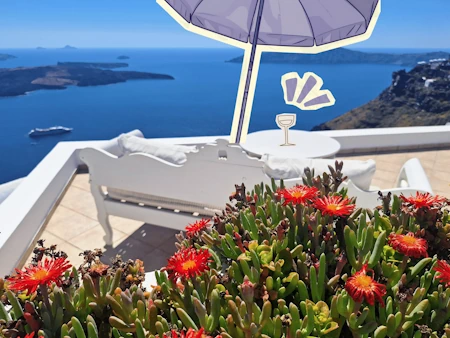
Santorini in One Sentence
Santorini isn’t difficult because it’s big.
It’s demanding because it’s intense, visible, and constantly shifting.
Why does Santorini feel more tiring than expected?
Santorini often feels more tiring not because of distance, but because of energy demand.
Movement requires effort, the environment is visually intense, and small decisions add up throughout the day. Even simple plans can feel full.
Is Santorini difficult to walk around?
Yes, more than most people expect.
Distances are short, but stairs, uneven paths, heat, wind, and crowds make movement more physically demanding than it looks on a map.
Can Santorini still feel relaxing?
Yes, but it doesn’t happen automatically.
Santorini feels best when you balance intensity with recovery, combining active moments with slower, grounded pauses.
How should I plan my days in Santorini?
Plan around energy, not just locations.
A day works best with one or two meaningful experiences, paired with time to pause and absorb, rather than constant movement.
What is the biggest mistake people make when planning Santorini?
Trying to optimize everything.
Too many transitions and micro-decisions create fatigue, even if the itinerary looks light on paper.
How many days do I need in Santorini without feeling rushed?
Most people need at least 3–4 days.
This allows enough time to move more slowly, understand the rhythm of the island, and avoid constant adjustment.
Is Santorini worth it if I want a relaxing trip?
It can be, but not in the way most people expect.
Santorini is naturally intense, visually, physically, and emotionally. It feels relaxing when you plan around that, with slower pacing and space between experiences, rather than trying to see everything.
Closing
Underestimating Santorini isn’t a mistake—it’s almost inevitable.
Clarity comes from naming constraints early, not discovering them late. Choosing “not now”, or choosing differently, is still choosing well.
This piece exists to help you decide with context, not pressure. Whether you come now or later, the experience will meet you differently when you understand how it works.
If you’re still unsure, send me a message and I’ll helps you figure out whether Santorini matches your travel rhythm right now.
Most people don’t need more options at this point.
They need clarity.
Comments
One response to “Why Santorini Feels Tiring (And How to Plan Around Your Energy)”
[…] This article has moved to:https://santorinibymaria.com/what-people-underestimate-about-santorini-before-they-arrive/ […]