
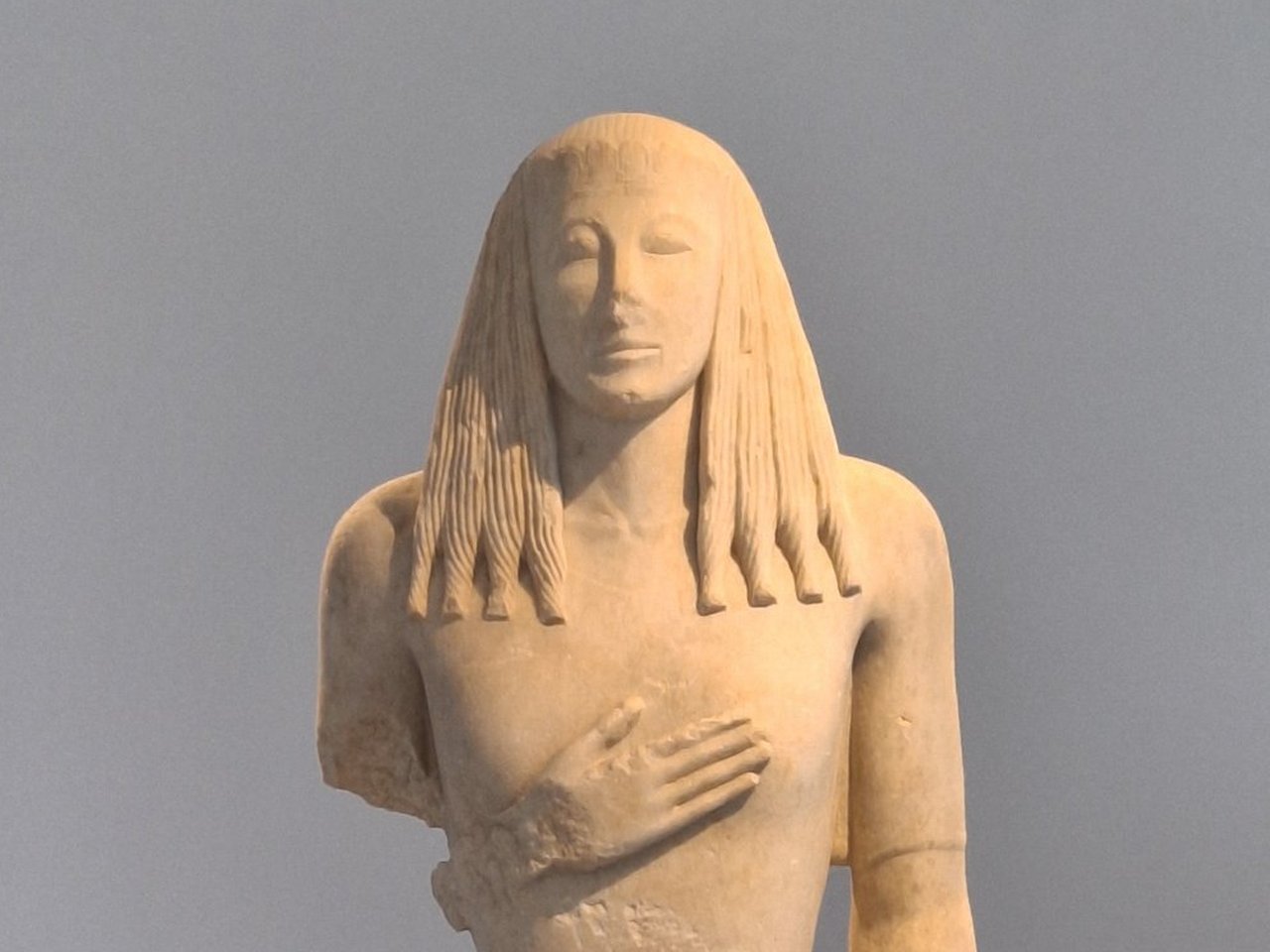
Quick answer: The Kore of Thera is a 2.48-meter Archaic statue in white Naxian marble, carved in the second half of the 7th century BC and found by accident in November 2000 during building work on a private plot, in the necropolis of ancient Thera. She’s one of the oldest and most complete Archaic korai anywhere: only the tip of her nose and one forearm are missing. She then spent 22 years in archaeological storage and was not shown to the public until September 2022. She now stands in the renovated Archaeological Museum of Thera in Fira.
The woman in the basement
A friend of mine has lived on this island for almost thirty years. For most of that time, if you wanted to see the Kore, you went downstairs.
The Kore wasn’t on display. She was in storage, and you met her by arrangement only, if you knew whom to ask.
What she is
She is 2.48 meters tall, carved from a single block of white Naxian marble, and she dates to the second half of the seventh century BC. She wears a long Doric peplos, and her right hand is bent against her chest.
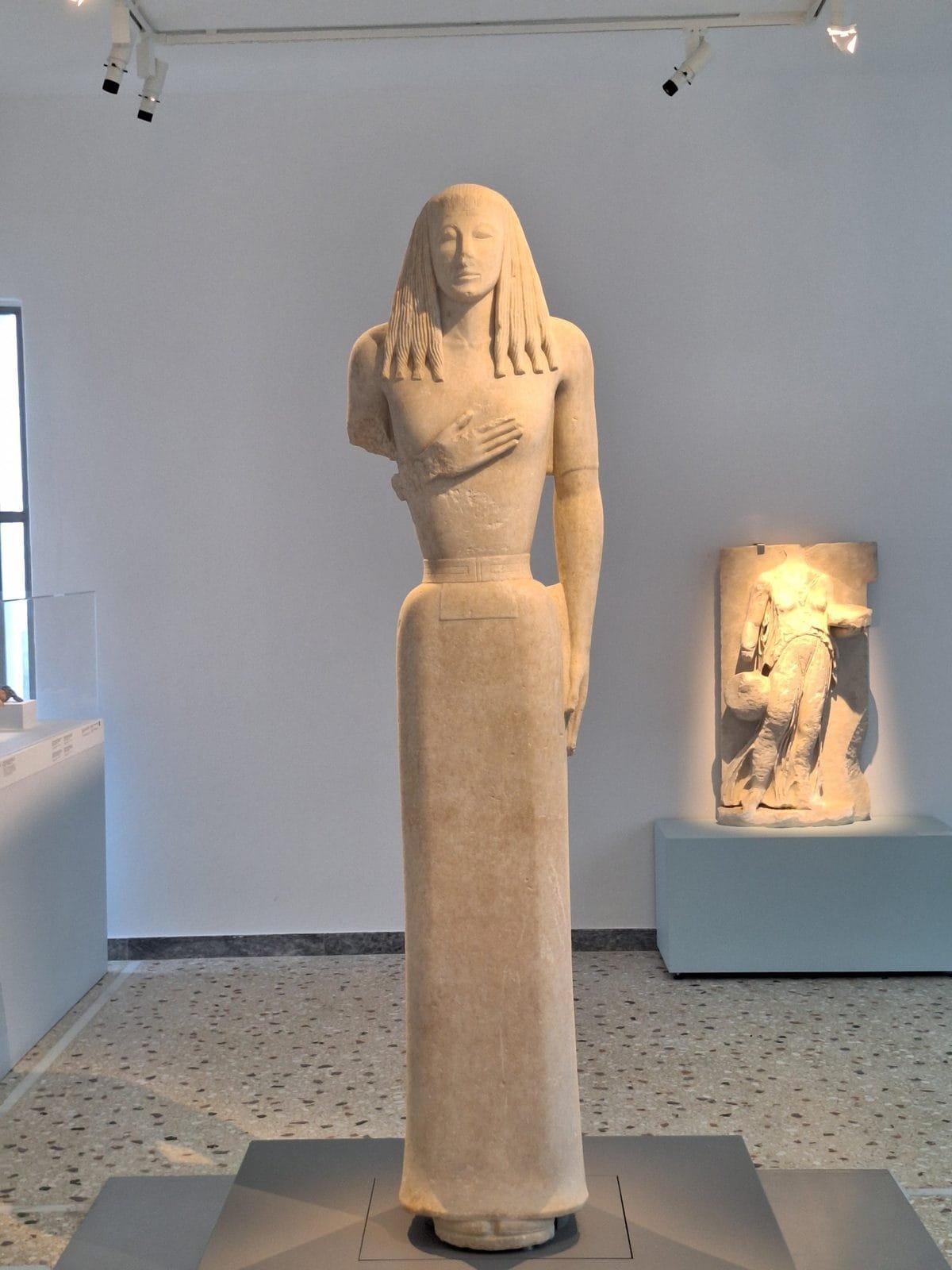
Two details matter more than the measurements.
The first: almost nothing is missing. From a colossal marble figure cut more than 2,600 years ago, the losses are the tip of her nose and the forearm of that raised hand. Large-scale sculpture from this period mostly survives as fragments, and the other statues of her type found in the same cemetery were in poor condition.
The second: there is a dowel at her base. She was cut to be fitted into a setting and stood upright. Somebody meant her to be looked at.
Archaeologists read her as funerary. She was found lying on her back in the ancient cemetery, beside a paved road leading into the city—but no base and no specific grave was ever matched to her, so whose she was is an open question.
How she was found
In November 2000, during construction on a private plot.
She was in a pit, almost intact, laid out; the excavation report describes it as though she had been buried deliberately. The Theran archaeologist Charalambos Sigalas stepped in to protect the archaeological zone, and the find turned into a fight: a legal dispute with the landowner over expropriating the site and over custody of the statue. At the time, the Athens press raised the possibility that the find had been concealed, or was headed somewhere it shouldn’t.
She was seized, conserved, and then she went into storage.
She came out on 4 September 2022—twenty-two years later, in a temporary exhibition opened by the Minister of Culture and attended by the President of the Republic.
The twenty-two years are not my arithmetic. The minister said the number out loud at the unveiling.
The room she’s standing in now
The Archaeological Museum of Thera reopened in June 2025 after a full renovation, and what reopened it was Kykladitisses: Untold Stories of Women in the Cyclades—roughly 180 objects gathered from 17 Cycladic islands, assembled by the Ephorate of Antiquities of Cyclades with the Museum of Cycladic Art and the Ministry of Culture.
It ran in Athens first, from December 2024 to May 2025. Then it came here.
Several of the objects in it had never travelled outside their home island before, and some had never been shown to the public at all. A Hellenistic Artemis hunting a stag, from Delos, shown off Delos for the first time. A fragment of a thirteenth-century saint’s face from a church on Naxos. A marble head from the House of Dionysus. A fourteenth-century icon of Saint Anastasia Pharmakolytria—”deliverer from potions”—from Naxos.
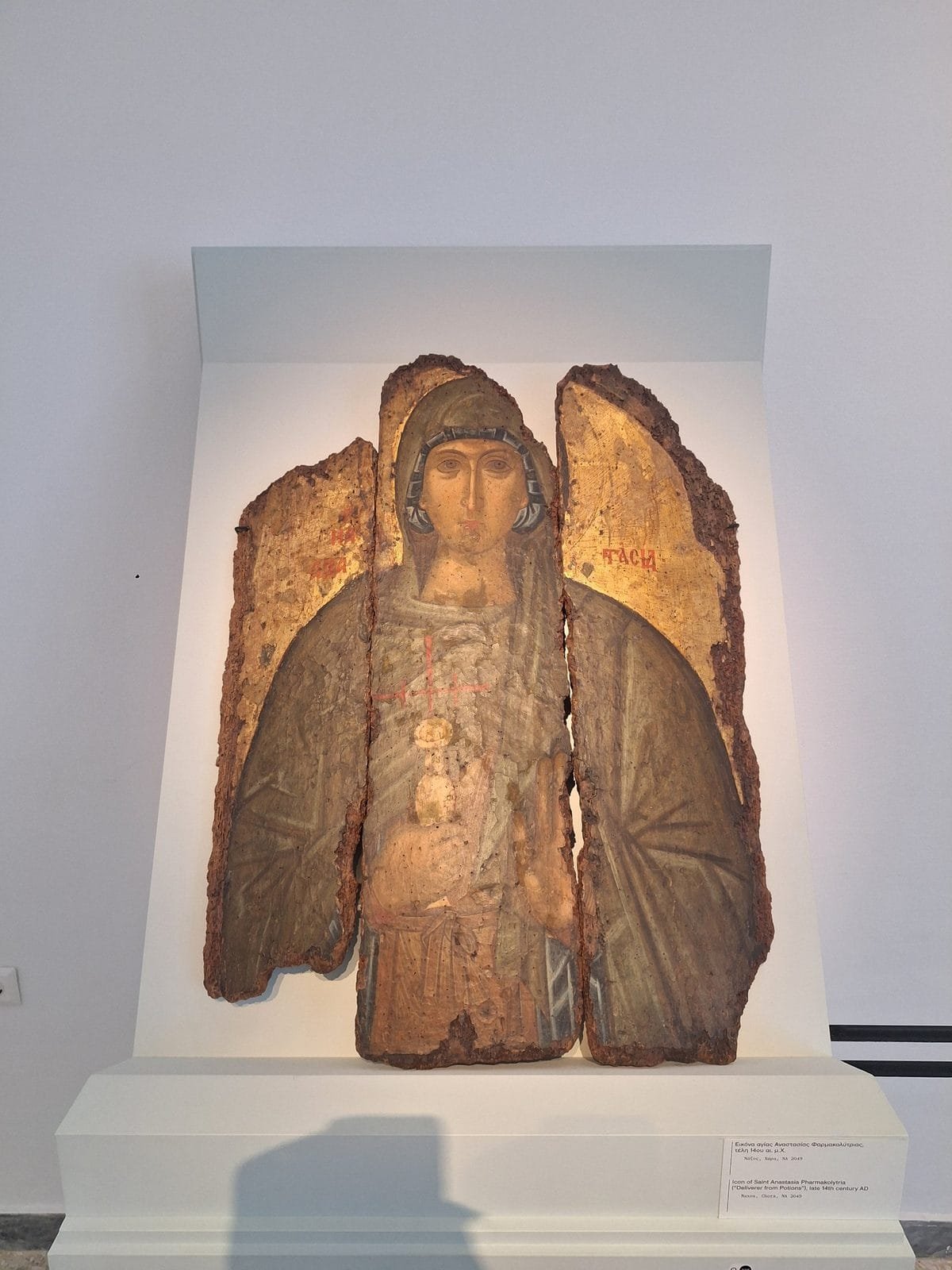
They are in Fira until the end of 2026, and then they go home.
The line you can walk in one room
Here is what makes this more than a good museum visit.
Start at the Egyptian goddess Isis, who arrives in the Cyclades at Delos and picks up a new name there: Pelagia, of the open sea. There’s a marble votive relief to her in the show, from the Agora of the Italians on Delos, early first century BC, a woman holding a billowing sail.
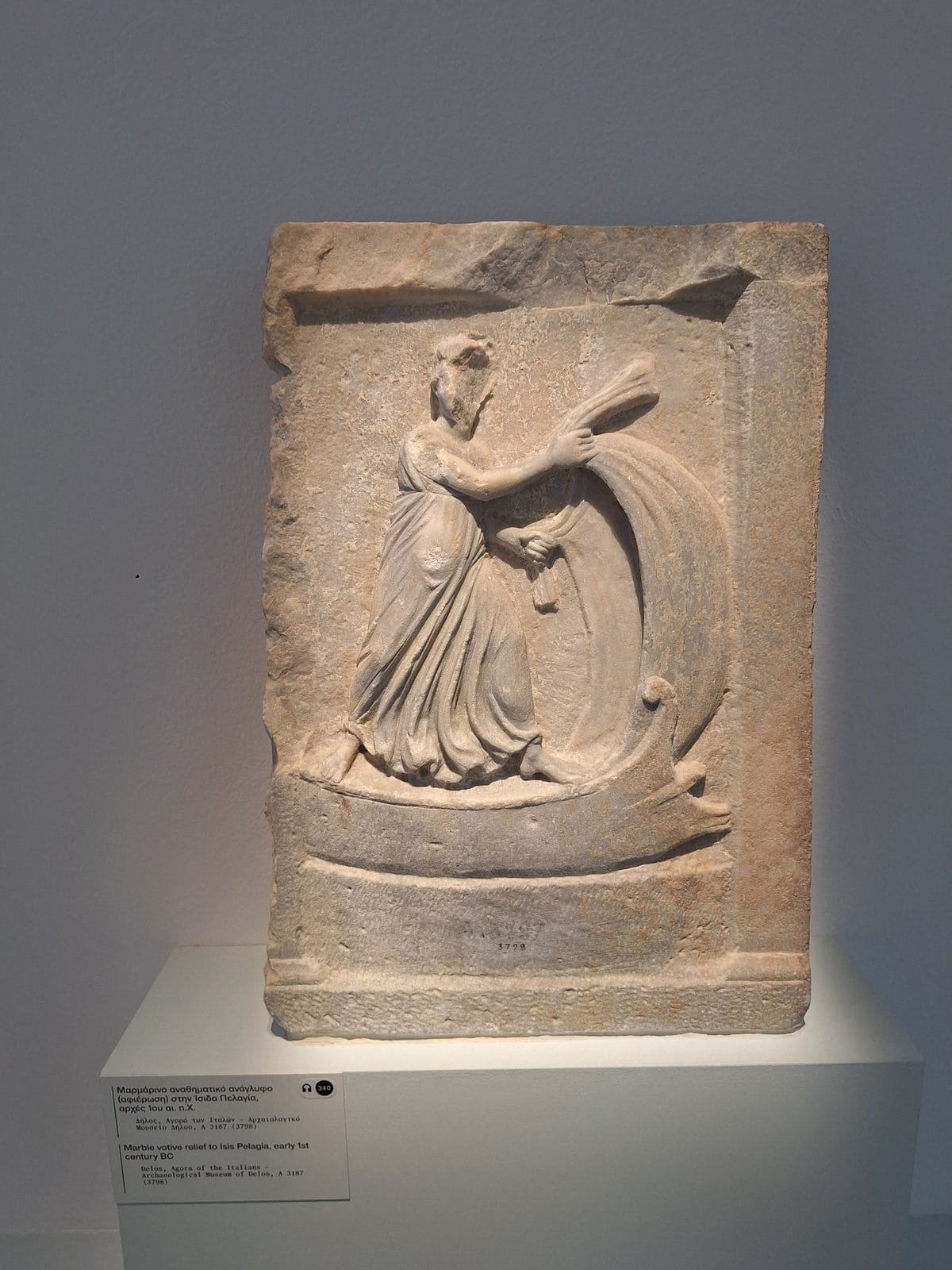
Walk a few rooms and you reach an icon from Melos. A ship in heavy weather, the Virgin above it, and an inscription recording the date the ship was saved: 17 October 1896.
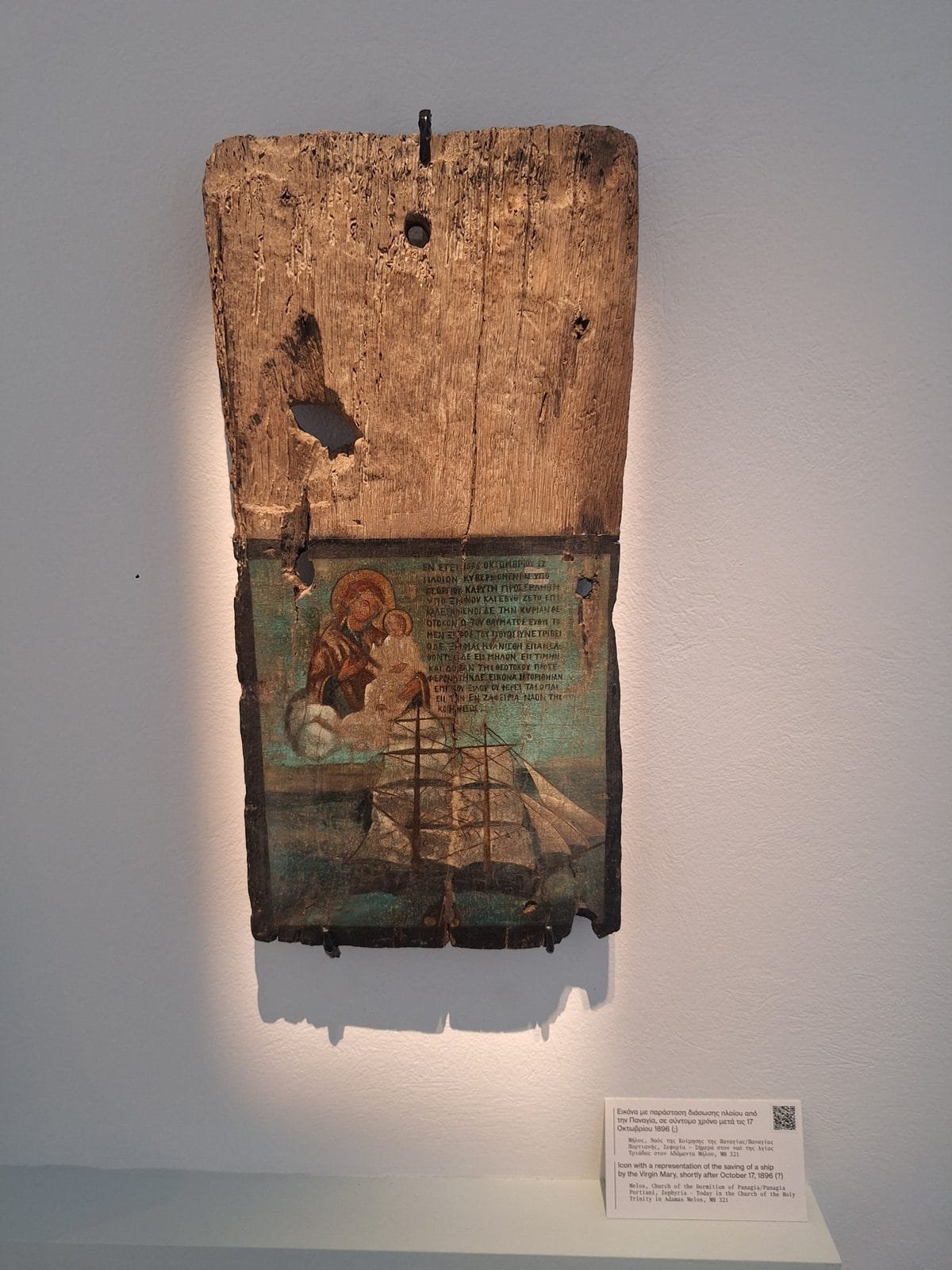
Same gesture of thanks, nailed to a board, eighteen centuries apart.
And the exhibition says so out loud. The wall text is explicit that Isis-as-Pelagia foreshadows the worship of the Virgin in these islands as Thalassini (of the sea), Pelagitissa (of the open seas), and Gorgona—mermaid.
If you’ve read what I wrote about the Panagia in August, this is the same thread, five thousand years longer. The women of these islands have always had somebody to ask about the weather.
Where the line breaks, and why that matters
Now the part most write-ups will skip.
The big folded-arm marble figure in the first room is labeled as a Great Mother-Goddess. It’s tempting—and very common online—to draw a straight unbroken line from her, through Potnia Theron and Artemis, to the Panagia, and call it one continuous religion of the mother.
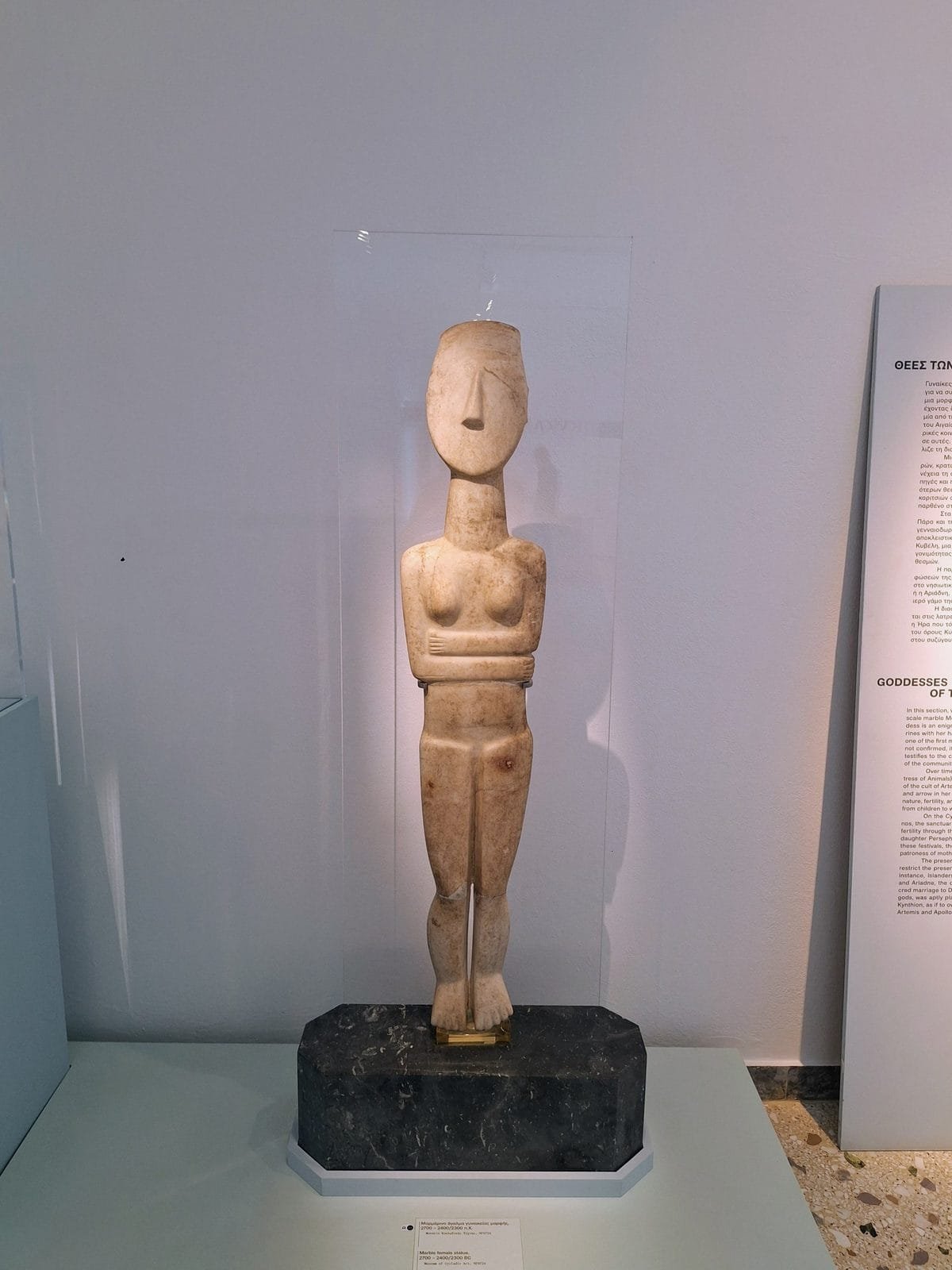
The museum itself doesn’t claim that. The wall text says her classification as one of the first monumental representations of a deity in the Aegean “is not confirmed.”
That hedge is the most honest sentence in the building, and it’s worth respecting. The Isis-to-Panagia line is documented: names, objects, dates, inscriptions. The figurine-to-goddess line is a reasonable reading that the evidence doesn’t close.
Collapsing the two makes a better story and a worse one at the same time.
The oldest women in the room are Theran
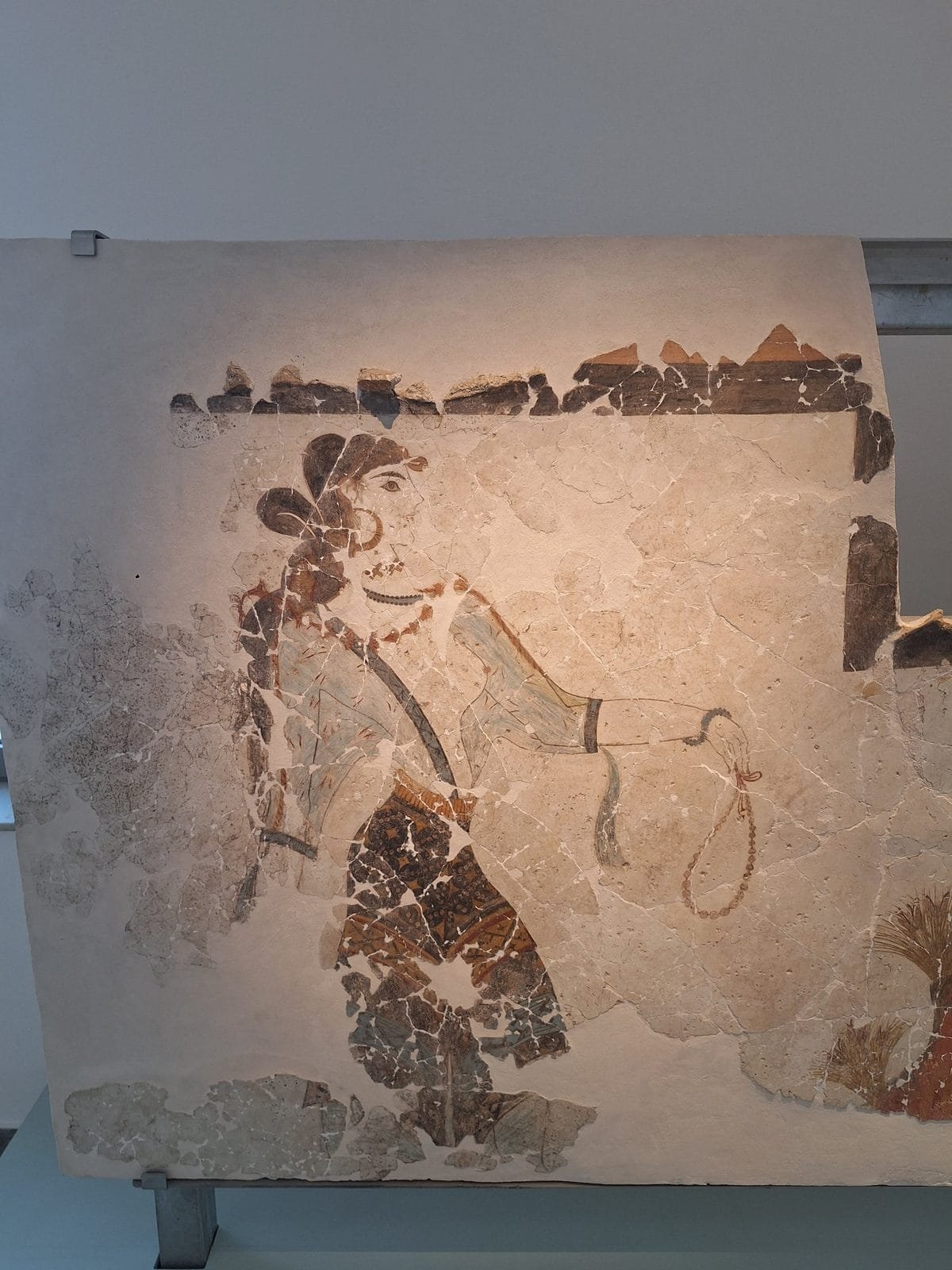
Facing the Kore is a wall of painted plaster nearly four meters long: the frieze of women from the adyton of Xeste 3 at Akrotiri, from about 1650 BC. They are the oldest women in the exhibition, and they never had to travel—they were already here, buried under this island, under ash, since before the Kore was carved by roughly a thousand years.
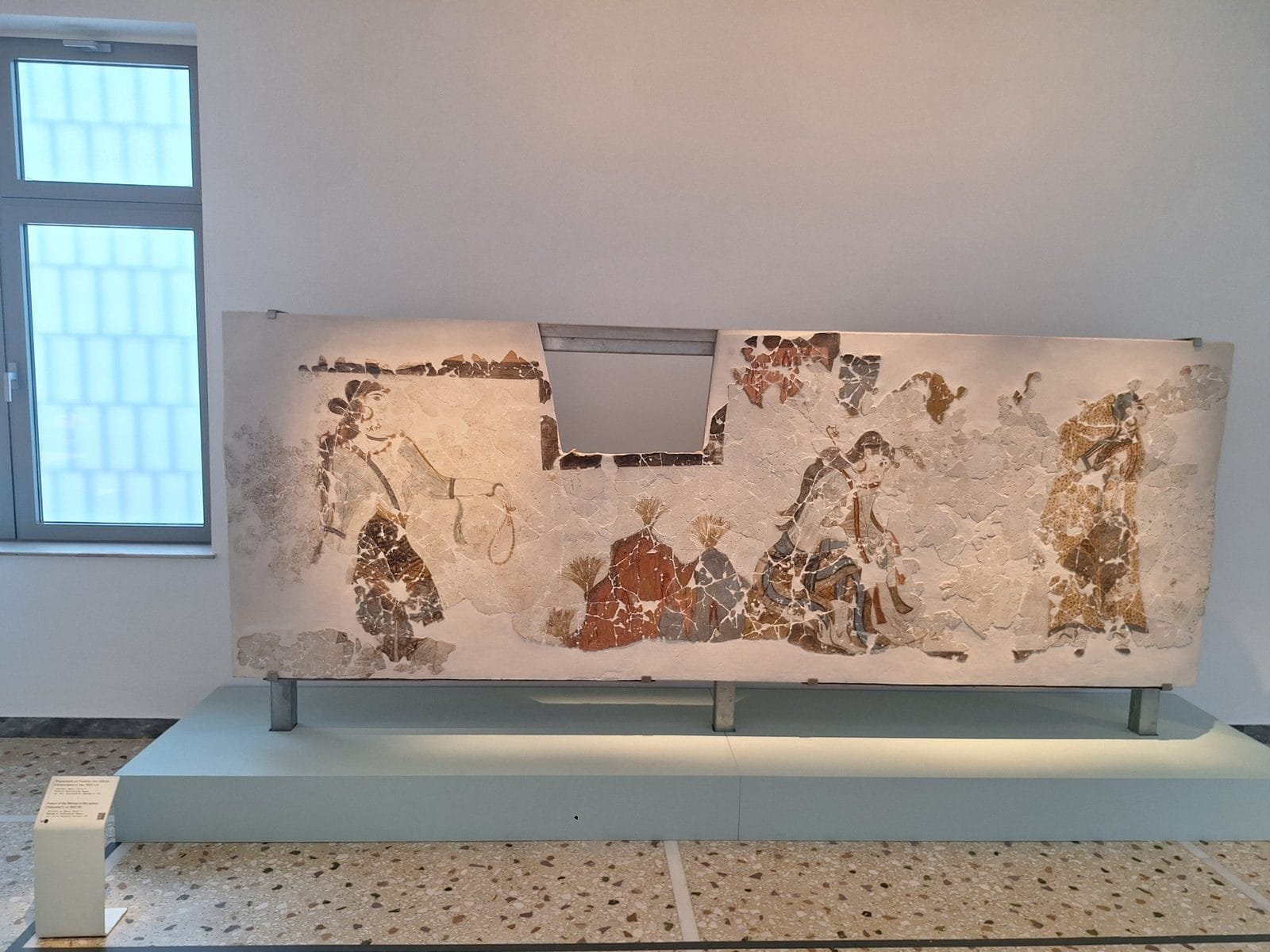
An exhibition that brought the women of sixteen other islands to Thera, and the oldest ones in it were Theran all along.
This week, the island does the opposite
For twenty years the island kept her downstairs. This Friday it puts her at the fore.
On 27 November, the Union of Parent Associations of the Municipality of Thira and the Oia cultural society Polites tis Oias open a student exhibition named after her: «Η Κόρη της Θήρας: Στο χθες, στο σήμερα, στο αύριο» (The Kore of Thera: in yesterday, today, tomorrow). Children from different countries and cultures have reimagined her. The work goes up at Ftelos Brewery in Karterados opening at 7:30pm, free entry, and running until 18 December.
There’s a second farewell folded into it. Ftelos is moving to a new building soon, and the one it leaves behind is the work of the Santorini architect Nikos Delendas, so the show is also a send-off for a building worth marking, the kind of local work the island doesn’t always stop to notice.
A seventh-century girl spent twenty years in a storeroom here. This week the island’s children named a show after her and hung it in the village where she was found. Hold those two facts next to each other.
So why was she in a basement?
Santorini has never been a place without history. In fact, we may have too much of it, too hard to reconcile: a Bronze Age town under volcanic ash, a Hellenistic city on a mountain, a seventh-century masterpiece in a building plot.
An economy with one extremely profitable product, and an attention span shaped around it.
A 2.48-meter Archaic kore spent two decades where only people who knew to ask could see her. Meanwhile the island sold a view.
Because there was no room for her, and no care to find any. Room here goes to what sells—the caldera, the pool, the photograph—and so does the attention. A 2.48-metre masterpiece needed a wall and a plinth; she got a storeroom, because nobody with the keys decided she was worth the space over the view. That is a choice, and the island keeps making it. She waited twenty-two years for someone to decide she mattered more than a sunset.
How to see her
She’s in the Archaeological Museum of Thera, in Fira, a few minutes’ walk from the main square.
There are two clocks here, and the difference matters.
Kykladitisses closes on 31 December 2026. After that the 180 borrowed objects go back to their islands—the Delos Artemis, the Naxos icons, the Melos shipwreck panel. If you want the exhibition, you have until the end of December.
The Kore isn’t going anywhere. She’s Theran. She was found on this island, she belongs to this museum, and her return is what reopened it. She’ll be standing there in the spring, and the spring after that.
General admission has been listed at €10. Winter opening hours changed on 1 November, so confirm the day’s hours rather than trusting a summer listing.
One thing worth planning around: state-run museums and archaeological sites in Greece are free on the first and third Sunday of each month, from 1 November to 31 March. This winter that’s:
1 and 15 November · 6 and 20 December · 3 and 17 January · 7 and 21 February · 7 and 21 March
Only four of those fall while the exhibition is still up—1 and 15 November are gone, which leaves 6 and 20 December to see all 180 objects for nothing. The Sundays after that still get you the Kore, the permanent collection, and an empty museum on a wet winter morning—not a bad trade.
A morning here pairs with the inland villages rather than the caldera, and a full private day can put the museum next to Karterados, where she came out of the ground. The plot is still a plot. If you’re here off-season, the what’s open in winter guide has the rest of the indoor island.
Frequently asked questions
What is the Kore of Thera?
The Kore of Thera is an Archaic statue of a woman, 2.48 metres tall, carved from a single block of white Naxian marble in the second half of the 7th century BC. She wears a long Doric peplos and her right hand is bent against her chest. Only the tip of her nose and the forearm of that hand are missing, which makes her one of the oldest and most complete Archaic korai anywhere, in a period when large-scale sculpture usually survives only in fragments.
Where was the Kore of Thera found?
She was found by chance in November 2000, during construction work on a private plot within the necropolis of ancient Thera. She lay on her back in a pit beside an ancient paved road into the city, almost intact and apparently laid out deliberately. The Theran archaeologist Charalambos Sigalas intervened to protect the site, and a legal dispute followed over the land and the custody of the statue.
Where can you see the Kore of Thera?
At the Archaeological Museum of Thera in Fira, Santorini. She spent 22 years in archaeological storage after her discovery and was shown to the public for the first time on 4 September 2022. She is a central exhibit of the renovated museum and remains on display there as a permanent part of the collection, after the temporary Kykladitisses exhibition closes.
Is the Archaeological Museum of Thera open?
Yes. The museum reopened in June 2025 after a full renovation. Winter opening hours in Greece change on 1 November, so confirm the day’s hours before setting out rather than relying on a summer listing.
What is the Kykladitisses exhibition?
Kykladitisses: Untold Stories of Women in the Cyclades is an exhibition of about 180 archaeological and art objects about the women of the Cyclades, gathered from 17 islands. Several of the objects had never travelled outside their home island before, and some had never been shown to the public at all. It was organized by the Ephorate of Antiquities of Cyclades with the Museum of Cycladic Art and the Hellenic Ministry of Culture, ran in Athens from December 2024 to May 2025, and reopened the renovated Archaeological Museum of Thera on 21 June 2025. On Santorini it runs until 31 December 2026.
How much does the Archaeological Museum of Thera cost?
General admission has been listed at €10 during the Kykladitisses exhibition. Reduced and free admission apply to certain categories, including EU residents aged 5 to 25. Prices and hours change with the winter season, so confirm before you go.
When are museums free in Santorini?
State-run museums, monuments and archaeological sites across Greece are free on the first and third Sunday of each month from 1 November to 31 March, and on several fixed dates including 28 October, 6 March, 18 April and 18 May. In the 2026–27 winter the free Sundays are 1 and 15 November, 6 and 20 December, 3 and 17 January, 7 and 21 February, and 7 and 21 March. The Kykladitisses exhibition runs until 31 December 2026, so the December free Sundays still catch it; the Kore stays on permanent display after that.
What is there to do in Santorini in winter indoors?
The island’s museums and archaeological sites stay open through winter on shorter hours, which makes them the reliable answer on a wet or windy day. The Archaeological Museum of Thera and the Museum of Prehistoric Thera are both in Fira and a few minutes apart, the Akrotiri archaeological site is under a modern roof, and the inland villages keep year-round tavernas and kafeneia that the caldera rim does not.
A day built around what’s actually open
Winter here is museums, villages and long lunches, and it needs someone who knows which doors are unlocked this week. Tell me your dates and I’ll build the day around them—including the Sundays when the museums cost nothing.
Leave a Reply