
WHY KARTERADOS
Sometimes the Santorini I want to show you is the one nobody photographed.
Karterados sits close to Fira, but it feels like a different tempo. The main roads carry people somewhere else. Inside the village, the details are smaller: a church courtyard, a bell tower above a narrow lane, cave houses built into the volcanic ground, a neighbour pausing in the shade.
This is the walk I choose when you have already seen the caldera and want to understand how people actually live on the island.
I am not taking you here because it is a secret. It is not. I am taking you because most visitors simply never slow down enough to notice it.
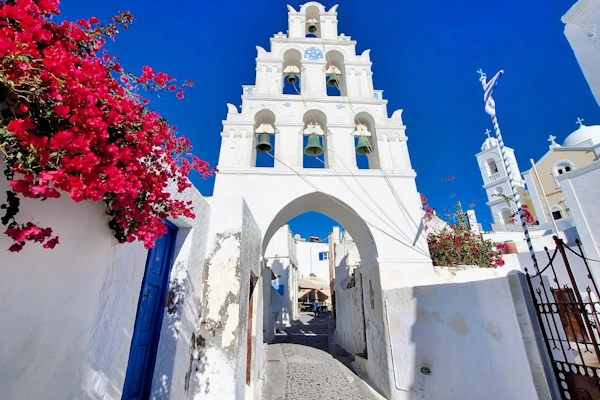
THE CHURCHES
Look up. Then slow down.
We move through Karterados by way of its churches and the spaces around them. The point is not to collect names or photograph every façade. It is to notice how the churches sit inside the village, how the lanes open and close around them, and how religious life is woven into ordinary daily movement.
There are moments when the loudest thing you hear is a bell, a cat moving through a courtyard, or someone talking from a balcony. That quiet is part of what I want you to experience.
When a church is open and it makes sense to enter, we can look inside respectfully. I never want the walk to feel like we are invading someone’s place of worship just to tick off another sight.
THE VILLAGE BETWEEN THE CHURCHES
This is where Karterados starts to feel personal.
Between the churches, we take the lanes as they come. Cave houses, old walls, small courtyards, whitewashed steps and volcanic stone tell you more about Karterados than a list of attractions ever could.
I like the pauses here. A bakery getting ready for the day. Coffee being poured. Cats finding the coolest patch of shade. Someone calling across a balcony. The village does not perform for us, and that is exactly why I like bringing people through it.
The route can change with the time of day, heat, church access and what is happening locally. I would rather take ten minutes to sit in a quiet place than keep walking simply because the itinerary says we should.
OPTIONAL LOCAL STOP
Stay for something small, if the day calls for it.
The core walk is about the village itself. But you can add a simple local stop at the end, depending on what you feel like.
Bakery: stop for something fresh and local, especially if you want a morning walk that feels connected to the village’s everyday rhythm.
Taverna: sit down for a simple local bite or drink and let the walk turn into a longer conversation. This is not a formal food tour, and I would choose the place and timing around the day rather than force a fixed menu onto the experience.
Tell me which sounds more like you when you enquire, and I will build the ending accordingly.
THE FEELING
You came looking for Santorini. You end up watching Santorini happen.
This is a slower kind of sightseeing. There is no pressure to get from one famous viewpoint to the next. We walk, stop, talk, notice and continue.
For me, the best part is often the ten minutes nobody planned. The light changes on a wall. A church door opens. We smell bread coming out of a bakery. Someone waves from a doorway. Suddenly you are not looking at Santorini as a destination. You are standing inside somebody else’s ordinary afternoon.
THE RHYTHM
Easy walking, but Santorini is still Santorini.
Allow around 2 to 2.5 hours for the core walk, longer if you add the bakery or taverna stop.
There are uneven stone surfaces, steps and occasional inclines. Wear comfortable shoes with grip, especially if the stone is warm or dusty.
I adjust the pace for heat, light and your energy. The goal is not to finish quickly. The goal is to leave feeling that you actually spent time somewhere.
Good to know
Duration: around 2 to 2.5 hours for the core walk.
Format: private walk with Maria.
Focus: village churches, cave houses, lanes, architecture and everyday local life.
Optional: local bakery or taverna stop.
Walking: uneven stone, steps and some inclines; comfortable shoes recommended.
Who should choose this
Choose Karterados if you want to get away from the sightseeing rhythm without travelling far from Fira.
It is particularly good for people who enjoy quiet streets, small details, local food, architecture, churches and conversations with their host.
If you want a long list of famous Santorini sights, this is not the route I would choose. Karterados works because we are willing to notice what most people walk past.
Karterados Churches Walk FAQ
How long is the Karterados Churches Walk?
The core private walk takes around 2 to 2.5 hours. Allow longer if you add the optional bakery or taverna stop.
How close is Karterados to Fira?
Karterados is only a few minutes from Fira, but the village feels much more residential and lived-in once you leave the main flow.
Is this a history tour of Karterados?
History and architecture are part of the walk, but this is not designed as a lecture. I use the churches, houses and lanes to explain how the village developed and how it feels today.
Can we stop at a bakery?
Yes. An optional local bakery stop can be added, particularly for a morning walk. The exact stop depends on what is open and what is fresh that day.
Can we eat at a taverna?
Yes. You can add a simple local taverna stop for a bite or drink. It is an optional extension, not a formal food tour.
Is the walk private?
Yes. This experience is designed as a private walk with Maria, so the pace and route can respond to you and to the village itself.
Will we enter the churches?
When a church is open and appropriate to enter, we can look inside respectfully. Access depends on the church and the time of day.
Is Karterados suitable for first-time visitors?
Yes, especially if you have already planned the famous caldera sights and want one experience that shows you a quieter side of everyday Santorini.
PLAN IT WITH ME
Want to see the quieter side of Santorini?
Tell me your date, who is travelling, and whether you would prefer to finish at a bakery, sit down at a taverna, or keep the walk entirely focused on the village.
Come walk Karterados with me.
Not because it is hidden, but because it is still a village.