
WHY PYRGOS
This is the village I choose when I want you to feel Santorini, not just see it.
Pyrgos is high enough on the island to change the way Santorini looks. As you climb through its lanes, the caldera stops being the whole story. You start seeing the island as a place people built, worked, worshipped, farmed and adapted to.
I like bringing people here when the brief is simple: less rushing, more noticing. We move through the old village at a pace that leaves room for the things that are easy to miss when you are following a standard sightseeing route.
There are arches, whitewashed walls, old houses tucked into the hill, small church courtyards and the fortified Venetian Kasteli. Some corners are beautiful because they are photogenic. Others are interesting because they explain why the village is here in the first place.
THE WALK
We climb. We pause. We let Pyrgos set the pace.
The walk begins in the village and gradually works uphill through its older streets. I will point out the details I think are worth your attention, but I am not interested in giving you a running commentary while you hurry from one landmark to another.
There is time to stand under an arch. Time to look back down the lane. Time to notice how the houses use the slope. And time to ask the questions that usually get lost on a tightly scheduled tour.
When we reach the Kasteli, the view is not just a photo stop. It gives you a useful sense of how Pyrgos sits within the wider island.
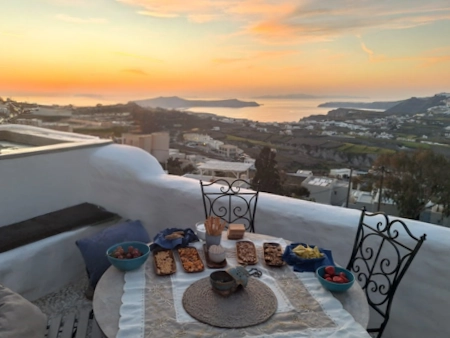
OLD CAPITAL · HILL VILLAGE · VENETIAN KASTELI
A DIFFERENT KIND OF SIGHTSEEING
The point is not to collect Pyrgos. It is to understand it.
Most visitors are shown the same visual shorthand for Santorini: blue domes, white walls, caldera views. Pyrgos gives us a chance to slow the picture down.
You see why a fortified settlement was built here. You see how volcanic terrain shapes the houses. You notice the difference between a village street that is still part of everyday life and a route designed mainly for visitors.
That is why I use Pyrgos as a grounding experience. It gives the island some depth before we return to the places everyone photographs.

THE HUMAN LAYER
Then we meet someone who makes the village feel less like scenery.
Depending on the day and the version of the experience we arrange, the walk can include a visit with a local artist whose work is rooted in Santorini and personal memory.
I value this kind of stop because you are not just looking at another beautiful building. You are meeting someone with a reason for being here, seeing how they work, and hearing the island explained through a person’s own relationship with it.
This is the part of my tours I cannot reproduce with a list of attractions. I am choosing people I know and trust, and connecting you with them when it makes sense for the day.
KISSIRAS · PYRGOS
And sometimes the walk ends somewhere you would never find from a map.
One of my favourite ways to finish the Pyrgos experience is at Kissiras, where brothers Marios and Mikhalis grow microgreens, edible flowers and seasonal produce.
What makes it interesting is not simply that it is a farm. It is the contradiction. Santorini is a dry volcanic island, and yet here you are looking at delicate greens being produced in a very different way from the vineyards and dry-farmed crops you might expect.
We can see the growing space, talk about what they are producing, and then sit down to eat. The connection between the place and the food is immediate because you have just seen where part of it came from.
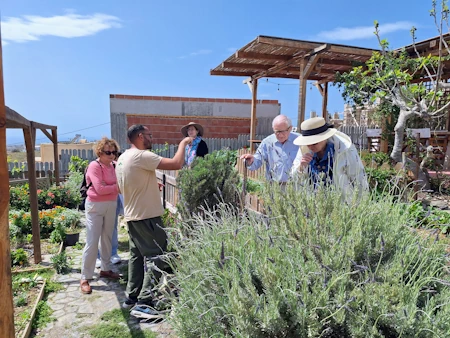
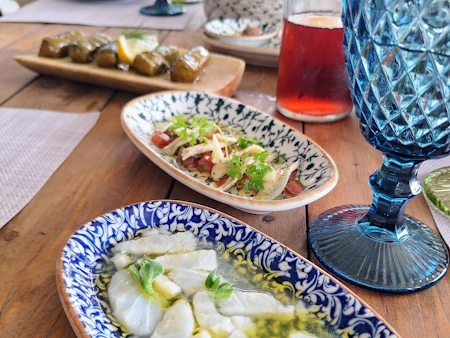
THE TABLE
This is where the walk stops feeling like a tour.
If we include the Kissiras ending, the meal is deliberately unhurried. It is not a restaurant where the next table is waiting for you to finish.
There may be a long table, sharing plates, produce from the farm, house wine and conversation. The exact menu follows what is available rather than pretending Santorini has a fixed tasting script.
For me, the best outcome is not that you can name every dish. It is that you leave knowing two people by name instead of one village by sight.
THE RHYTHM
Give Pyrgos time and it gives something back.
The whole experience is usually around 3 hours, longer if we include a relaxed food ending. The timing matters. Heat changes the feel of the hill. Light changes the colour of the stone. The village is not the same at 10 in the morning as it is later in the day.
I also do not treat the route as sacred. If it is particularly hot, we change the rhythm. If something interesting is happening, we stop. If you are tired, we do not push on just because the itinerary says we should.
The flexibility is not a bonus feature. It is how I think a village walk should work.
GOOD TO KNOW
Is Pyrgos right for you?
Choose this if: you want a quieter side of Santorini, enjoy architecture and local stories, prefer walking to bus touring, or want an experience with real people rather than a sequence of viewpoints.
Think twice if: you want a completely flat route, a fast sightseeing checklist, or your main priority is staying on the caldera.
Walking: expect uphill sections, steps, uneven stone and warm surfaces in summer. Comfortable shoes matter more here than fashionable ones.
Private experience: the route and any added stops are arranged around your day, interests and comfort.
PLAN IT WITH ME
Want to know if Pyrgos makes sense for your Santorini day?
Tell me where you are staying, your dates, how much walking you enjoy, and whether you want the walk to end with art, food, wine or simply more time in the village.
I will tell you honestly whether Pyrgos is the right choice. If it is not, I would rather send you somewhere that fits better.
Pyrgos Village Walk FAQ
How long does the Pyrgos Village Walk take?
The walking experience is usually around 3 hours. If we add a longer food or farm ending, I allow more time rather than rushing the final part.
Is the Pyrgos walk difficult?
I would call it easy to moderate, but it is not flat. Pyrgos is built on a hill, so expect uphill streets, steps and uneven stone. I adjust the pace to the people I am walking with.
What will we see in Pyrgos?
We walk through the older village, the lanes around the Venetian Kasteli, church courtyards and residential streets, with the emphasis on architecture, village history and the details that are easy to miss on a quick visit.
Can we include the artist visit?
Yes, when the artist stop is available and fits the timing of your walk. I prefer to arrange it as a genuine meeting rather than treat it as another scheduled photo stop.
Can we include Kissiras and the farm-to-table meal?
Yes. This is one of my favourite endings to the Pyrgos experience, but it needs to be planned around availability and timing. I will confirm the version that works for your date.
Is the Pyrgos walk private?
Yes, this experience is designed as a private walk shaped around your group rather than a fixed large-group sightseeing route.
Can the route change because of the weather?
Absolutely. Pyrgos is a hill village, and heat matters. I would rather change the order, shorten a section or slow down than force a fixed itinerary on a hot day.
Come up to Pyrgos with me.
Not to tick off another village, but to spend a few hours actually being in one.