
Do art and music in Santorini still have their place or has the island lost its voice because of overtourism?
Santorini actually has a vibrant cultural life: art studios, galleries, temporary exhibitions, a cultural center built around ancient Greek instruments—and nearly all of it sits inland, indoors, and away from the caldera route and the infamous crowds. That makes it the answer to two questions at once, because in August and September the hottest hours and the most crowded ones overlap quite a lot, in the same two locations.
The island used to have bagpipers in every village until the tradition died out completely. And then, a musician from the mainland went looking for what was left of it, and that’s where this story begins.
Every village in Santorini used to have a piper; one day it all went silent
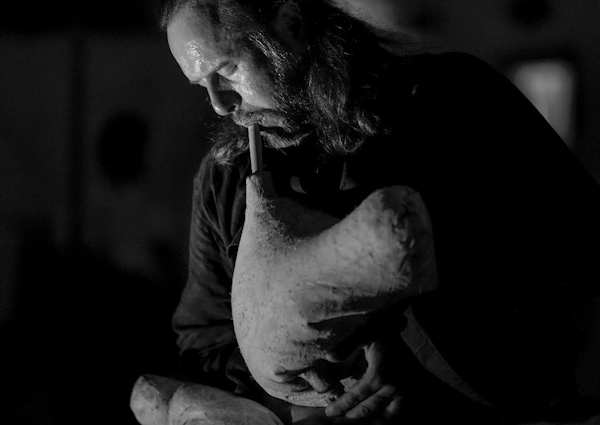
The tsampouna is a goatskin bagpipe; loud, old, built for celebrations rather than concert stages. Every village on this island once had someone who played it—and then, on Santorini specifically, it all went silent.
Yannis Pantazis went looking for what remained. He found Vangelis Maroulis, the last piper in Oia, shortly before the latter passed away. Maroulis played for him, though, and gave him his uncle’s instrument.
In Akrotiri there was a man named Arvanitis, a great player. He had never taught anyone. The pipes were his living—he played at the village feasts and sold rabbits — and a student would have been competition. His own nephew had asked to learn and had been told his fingers were too fat for it, so the tradition nearly died out with him.
Yannis’s first student was the last piper’s grandson
He found the instruments of Santorini’s old pipers, one by one, along with photographs and recordings, and put the island’s sound back into use. Most of that collection is on display in Megalochori now, and it’s the same collection from the set of Christopher Nolan’s The Odyssey — that story is here.
For more about Yannises’ search for the bagpipe melodies, you can listen to the wonderful interview here with Farya Faraji & World Musicians:
Art and music in Santorini: Where do they fit in an August day
Nearly all of it is inland, indoors, or under vaulted ceilings, built especially for the heat—which is why it all belongs in the middle of the day, when the caldera villages are at their hottest and fullest at the same time. I explain that in full in Santorini in August, including why a carved room stays cool without air conditioning.
Why cultural spaces don’t fill up like the more “touristy” ones do
Simple math: a music workshop or a pottery studio can only take in so many bookings. An instrument-making workshop runs an hour with a small group, and a gallery in a converted cellar has only one room, meant for the discerning few. There’s no pressure and no competition for the “best spot.”
Places that can’t absorb a bus full of people don’t accept one. It’s not some secret insider knowledge, just capacity.
That being said, the practical consequence is most of them do need advance notice and local coordination rather than a walk-in, especially in August and September.
Art and music in Santorini on the map
Megalochori makes the most of its limited lanes: Symposion, three pottery studios, a wood-carver, a leatherworker, Minoan-inspired jewelry, and so much more. You can spend a whole afternoon just exploring the village crafts there.
Vlychada has the Tomato Industrial Museum, a former tomato cannery now used for exhibitions and performance, right beside the newly opened Santo Wines sister. At sea level, so both pair with a refreshing swim.
Akrotiri, besides its ancient history, is home to a wonderfully creative local family of Melina’s Tavern, hosting art and lava rock sculpting classes.
Messaria is well on its way to becoming a permanent base for the local creative scene, all thanks to Yorgos Kypris.
Oia has real galleries too, behind the shopfronts., but that’s a different post for another day.
Art and music in Santorini right now, Summer 2026
Birds of Passage, Megalochori, 6 August to 20 September
The Athens gallery CYPHER has taken over Hiraeth Santorini, a group of three houses in Megalochori, and turned them into an exhibition space for the summer. The houses stop taking guests for the duration. Instead of people, the rooms hold paintings: work by nine Greek and international artists, hung alongside pieces that already belonged to the house.
Curated by Isavella Kladaki.
The opening is Thursday 6 August at 18:00, with a live set from the electronic duo Aquatic Ensemble at 20:00.
MATI Mesaria, with Yorgos Kypris
MATI has a permanent collection you can walk through with a guide, and this year visitors have heard the work explained by Kypris himself. Two formats: an art tour of the permanent exhibition, or a wine-and-art version that puts a tasting alongside the looking. Both can be added to your island tour or booked directly through the gallery.
Sip & Paint, at Akrotiri beach
A family restaurant runs a daily sip-and-paint session led by the artist Veronika Katri: wine, home cooking, and step-by-step guidance whether or not you’ve held a brush before. It runs every day, and it works in the afternoon heat because the sea does the cooling instead of stone. Bookable by individual inquiries – ask me for special rates.
INDUSTRIANA, Tomato Industrial Museum, Vlychada, until 31 October
The Tomato Industrial Museum in Vlychada is showing the industrial history of Santorini and Thirasia: archive material, tools, machinery, and recorded testimony from the people who worked the factories, gathered in one place for the first time. It came out of research by the Theraic Society of Sciences, Letters and Arts, with support from Cycladic Identity.
What a cultural day looks like
Morning, while it’s cool: walk. My village walks run in these hours all summer for that reason.
Midday: inland and indoors. A workshop, a cellar, a long lunch, a presentation.
After five: the wind comes back, and the famous places are worth standing in.
The version built around music and making things is the Art & Music Day, designed per guest rather than scheduled, because these places take small numbers.
Art and Music in Santorini: Frequently Asked Questions
Is Santorini a cultural destination?
Yes, though it doesn’t advertise itself that way. The island has working galleries, pottery and marble studios, a cultural center dedicated to ancient Greek instruments, summer festivals, and village feast traditions. Most of it sits inland, away from the caldera route.
What is there to do in Santorini when it’s too hot?
Go inland and indoors. The studios, galleries, and cultural spaces are in the inland villages—Megalochori, Messaria, Vlychada, Pyrgos—and many occupy rooms carved into volcanic rock, which stay in the high 20s C (low 80s F) while streets outside reach 33°C (91°F).
How do you avoid the crowds in Santorini in summer?
Move against the schedule. Visitors concentrate in Fira and Oia between roughly noon and five, when ships are in port. Spend those hours inland, and visit the caldera villages before 11am or after 6pm.
What is Symposion in Megalochori?
A cultural center built around ancient Greek instruments, mythology, and live performance, run by the musician and instrument maker Yannis Pantazis. It offers daytime presentations, a pipe-making workshop, and evening performances. Book ahead in August and September.
Can you take an art or pottery class in Santorini?
Yes. Pottery and marble studios take visitors by arrangement, and Symposion runs an instrument-making workshop. There’s also a daily sip-and-paint session by the sea at Akrotiri beach, led by a professional artist, with no experience needed. Capacity is small everywhere, so contact them before you arrive rather than the morning you want to go.
Are there art exhibitions in Santorini in summer 2026?
Yes. Birds of Passage, a group painting exhibition presented by the Athens gallery CYPHER, runs from 6 August to 20 September 2026 at Hiraeth Santorini in Megalochori, where three houses are given over to the show for the season. INDUSTRIANA, an exhibition on the industrial heritage of Santorini and Thirasia, runs at the Tomato Industrial Museum in Vlychada until 31 October 2026.
Do cultural experiences in Santorini need booking in advance?
Usually. Some studios operate by appointment only outside peak season. A week’s notice is sensible in August and September, particularly for evening performances.
Santorini Art & Music Day
Tell me your dates, and I’ll take it from there.